
Comparisons & Reviews
Best AI Tools for Insurance Agents in 2026
The best AI tools for insurance agents automate lead response, policy follow-up, claims intake, and compliance documentation.
The free 30-minute AI Operations Audit is a conversation about a normal week in your business and where the work piles up. We find the one change that would give you the most time back and send you a plain-English plan for it. No forms and no pitch.
Book a free AI audit
Patrick Gibbs
Evaluate insurance automation around the work your agency actually handles: lead response, policy follow-up, claims intake and record updates. Measure call volume, review time and the accuracy of handoffs before comparing an AI workflow with existing staff coverage.
Why Insurance Agents Need AI Tools
Insurance agents balance inbound inquiries with paperwork, policy research and compliance. Review your agency’s call logs to see when inquiries wait or reach voicemail. Separate routine status questions from calls that need a licensed professional before choosing what to automate.
The insurance sales cycle compounds this problem. A quote request arrives, the agent researches coverage options, prepares a comparison, follows up, and then follows up again. Most quotes require 3-5 touchpoints before conversion, and each touchpoint is manual. AI tools compress that cycle by handling the initial intake, sending the comparison automatically, and scheduling the closing conversation at a time that works for both parties.
Claims calls add another layer of difficulty. When a policyholder has an accident or damage, they want to talk to someone immediately. AI phone systems can triage claims calls by collecting policy number, date of loss, and basic details, then routing to the right adjuster or claims desk. This reduces abandoned calls during claims events and improves the policyholder experience without adding headcount.
How We Evaluated the Best AI Tools for Insurance Agents
We evaluated each tool on 12 criteria: lead response speed, policy follow-up automation, claims intake capability, compliance features, integration with agency management systems, mobile access, pricing fairness, setup time, support quality, API breadth, ROI timeline, and user satisfaction. Only tools with measurable adoption in the insurance industry were included.
Evaluation Criteria
- Lead Response Speed - Does the tool answer inbound calls within seconds and qualify the prospect before agent involvement
- Policy Follow-Up - Automated sequences for renewal reminders, cross-sell opportunities, and orphan policy outreach
- Claims Intake - Ability to collect claim details including policy number, date of loss, and damage description
- Compliance Features - Recording, documentation, and audit trails for regulatory requirements
- Agency Management - Verified access to your selected agency-management system, such as AgencyBloc, AMS360 or Applied Epic
- Quote Generation - Integration with comparative raters and policy administration systems
- Mobile Access - Functionality for agents working from client meetings or field appointments
- Pricing Model - Predictable monthly cost without per-quote or per-policy fees
- Setup Time - Hours to operational deployment, including phone number porting and workflow configuration
- Support Quality - Insurance-specific training, compliance guidance, and response SLAs
- ROI Timeline - Expected weeks to recover the tool's monthly cost through captured leads
- User Reviews - Aggregate agent ratings and churn data from insurance-specific deployments
Best AI Tools for Insurance Agents Quick Reference
Best for Lead Response and Call Handling
Epiphany Dynamics AI Voice Receptionist can be scoped for inbound intake and consultation requests. A discovery review must confirm the selected phone provider, agency-management system access, logging permissions and human escalation process. Test each proposed integration; this article does not promise native support for every AMS or successful logging of every interaction.
Best for Agency Management and Policy Workflow
When evaluating policy workflow software such as AgencyBloc, test the renewal, commission and reporting steps your team actually uses. Measure time spent resolving exceptions as well as time saved entering information; a feature list does not establish a percentage reduction in administration.Best for Quote Comparison and Delivery
EZLynx and SimplyConnect provide comparative rating tools that integrate with AI intake systems. When an AI receptionist captures a quote request, it can trigger an automated comparison from multiple carriers and email the results to the prospect within minutes.
Best for Claims Triage
AI-powered claims triage tools like Claimatic or custom-configured voice bots collect essential claim information, categorize urgency, and route to the correct adjuster. This cuts first-notification-of-loss processing time from hours to minutes.
Best for Compliance and Documentation
Tools that automatically record and transcribe calls, log policy changes, and generate audit trails are essential for insurance compliance. AI voice platforms with built-in recording and storage meet most state regulatory requirements for call documentation.
Further reading: Best AI Agency for Insurance in 2026.
How to Choose the Right AI Tools for Your Insurance Practice
Start with a measured interaction bottleneck. Pilot an AI receptionist for initial intake and qualification, record review and recovery work, and compare the net time change with your baseline. Add policy follow-up or claims routing only when the relevant pilot is reliable.
For an illustrative third-party budget worksheet, compare a $200-400/month software allowance for one producer with a $400-800/month allowance for a larger workflow. These are sample inputs, not current vendor quotes or evidence that a front desk role can be eliminated. Include setup, phone usage, supervision and the work that remains with your team.
The insurance industry is heavily regulated, so compliance features in AI tools are non-negotiable. Make sure your AI platform records all calls, maintains audit trails, and supports state-specific disclosure requirements. Most platforms designed for insurance handle this out of the box, but consumer-grade voice tools may not.
Frequently Asked Questions
What is the best AI tool for insurance agents?
The best AI tool for insurance agents depends on the workflow you need to automate. Per the Quick Reference list above, Epiphany Dynamics is the best pick for lead response and call handling, AgencyBloc for agency management and policy workflow, EZLynx or SimplyConnect for quote comparison and delivery, and Claimatic for claims triage. Most agencies combine a few of these tools, and whatever you choose should include call recording, disclosure, and audit trails to stay compliant with state insurance regulations.
Can AI tools for insurance agents handle compliance requirements?
Yes, AI voice tools designed for insurance include call recording, disclosure playback, and audit logging. These meet most state regulatory requirements for documenting customer interactions. You should verify that your specific state's recording consent rules are supported.
How much time do AI tools save insurance agents?
Measure call handling and policy follow-up separately before launch, then repeat the measurement after the pilot. Subtract time spent correcting records and handling escalations. Report the net hours recovered by your agency; there is no supported universal weekly saving or 30-day outcome in this guide.Do AI tools integrate with my current insurance software?
Ask each vendor to demonstrate the exact connection to your agency-management system and rater provider. Confirm supported records, permissions, synchronization direction, failure alerts and ongoing maintenance before treating an integration as available.
Can AI handle claims calls?
AI can handle first-notification-of-loss calls by collecting the policy number, date of loss, type of incident, and basic description. Complex claims with multiple parties or disputed liability still require human adjusters, but routine fact collection can be assisted, with review and escalation for uncertainty.
For more details on how AI voice systems handle high-volume phone environments, see our AI phone answering tools guide. If you want to discuss the specific compliance requirements for your state, book a consultation and we can walk through the details.
Patrick Gibbs
AI Automation Expert
Patrick Gibbs helps professional practices implement AI automation that captures more leads, books more appointments, and scales without adding overhead. He's the founder of Epiphany Dynamics and creator of the AI Front Desk system.
Related Solutions
Build this into a real workflow
Related Posts
Best AI Receptionist for Small Business: How to Choose
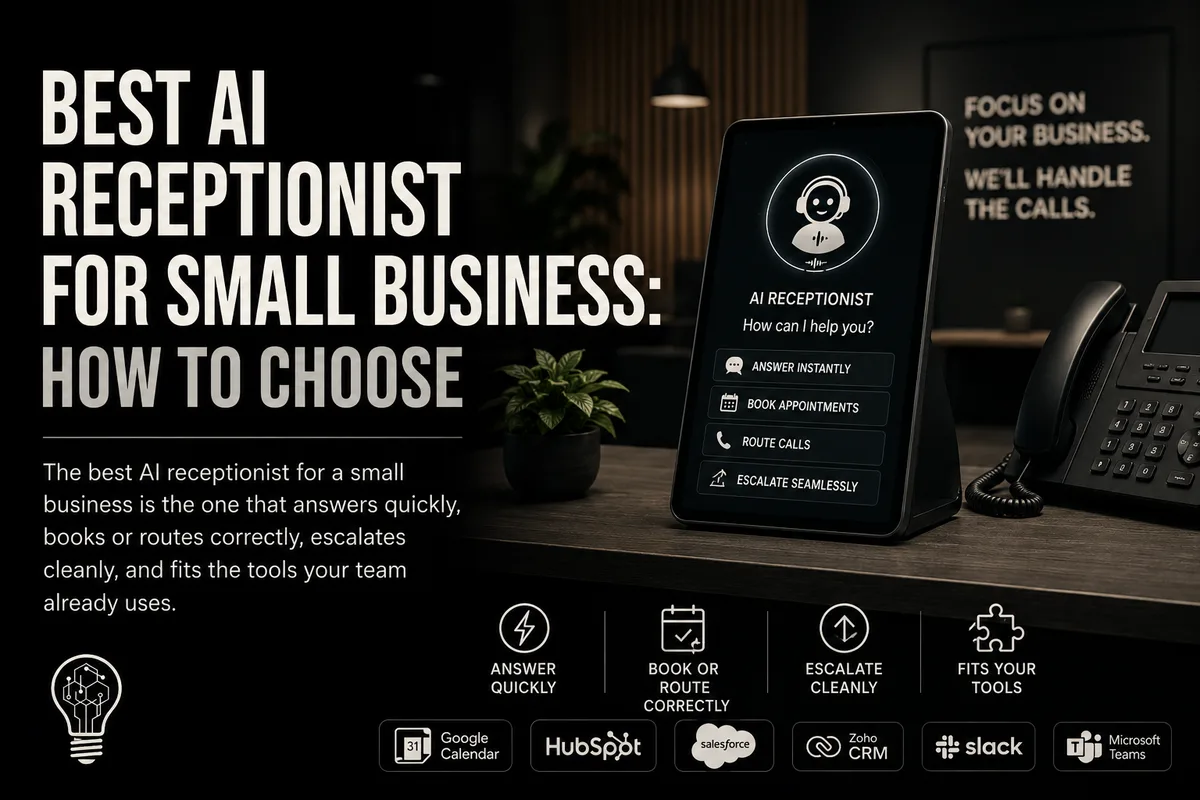
The best AI receptionist for a small business is the one that answers quickly, books or routes correctly, escalates cleanly, and fits the tools your team.

Ruby Receptionists Alternatives in 2026: What's Worth Switching To
Ruby's per-minute model can get painful at higher call volumes. Here's a straight comparison of the alternatives actually worth evaluating, including AI.

AI Automation Cost for Real Estate Agents: 2026 Pricing Guide
Most real estate agents either overpay for automation tools they barely use or underinvest and wonder why leads keep going cold.