
AI Automation
How Do I Get My Business Recommended in ChatGPT, Perplexity, Gemini?
Learn what actually helps a business get named in AI answers: entity clarity, verifiable evidence, citable page formatting, and honest limits on control.
The free 30-minute AI Operations Audit is a conversation about a normal week in your business and where the work piles up. We find the one change that would give you the most time back and send you a plain-English plan for it. No forms and no pitch.
Book a free AI audit
Patrick Gibbs
Getting recommended by ChatGPT, Perplexity, or Gemini is not a service anyone can guarantee. It comes from three things you can control: making your business unambiguous online, publishing evidence a model can verify, and writing pages that answer specific questions clearly. No agency, including this one, can promise a citation or ranking inside an AI answer.
What “recommended” actually means in AI answers
AI systems do not maintain a directory of approved businesses. When a model names your business in an answer, it is pulling from a mix of web content, structured data, and prior training, then generating a response that happens to match what it found. There is no submission form and no paid placement.
This matters because a lot of AI search advice is written as if these tools work like a review platform with a ranking algorithm you can game. They do not. Perplexity and Gemini lean more heavily on live web retrieval, so recent, well-structured pages have a real shot at being pulled into an answer. ChatGPT’s behavior depends on whether it is browsing the web for that specific query or answering from what it learned during training, and you cannot always tell which mode produced a given response.
The practical result: you cannot target “get cited by ChatGPT” as a deliverable. You can target the things that make citation more likely across all three, which is a different and more honest goal.
Entity clarity: make your business unambiguous
Entity clarity means an AI model can determine, without guessing, who you are, what you do, where you operate, and how you differ from businesses with similar names. If your name, address, service list, and description vary across your website, Google Business Profile, and directories, models have less confidence linking a query to you.
Start with consistency, not creativity. The name of your business, your city and service area, your core services, and your hours should read the same way on your website, your Google Business Profile, your Facebook page, and any directory listing you control. If you are a plumbing company in three suburbs but your website only mentions the flagship city, an AI system answering “plumber near [suburb]” has no clear reason to include you.
Structured data helps here too. Adding schema markup (LocalBusiness, Service, FAQPage) to your site gives machines a labeled version of the same facts humans read, which reduces ambiguity. This is one of the concrete things covered under AI Search Engine Optimization, since entity clarity and structured markup are foundational to how these systems parse a site at all.
Useful evidence: what AI systems actually pull from
Models weigh content that reads as verifiable over content that reads as promotional. Specific numbers, named case studies, dated results, and third-party mentions carry more signal than adjectives like “best” or “trusted.” If your site only has a homepage and a contact form, there is little evidence for a model to summarize or cite.
Think about what a model would need to answer “which HVAC company in Dallas responds fastest after hours.” It would need a page describing that specific claim, ideally with a real example. A generic services page that says “fast, reliable service” gives nothing to quote. A page that walks through how a company eliminated missed after-hours calls, like the approach described in How Dallas HVAC Companies Eliminate Voicemail with AI, gives a model a concrete story it can paraphrase accurately.
The same logic applies to press mentions, client testimonials with specifics, and documented outcomes. Vague praise is not evidence. A named client, a described problem, and a described change are evidence, even without inflated statistics attached.
Citable pages: the format that gets used
Citable pages answer one clear question near the top, in plain language, before adding detail. Long intros, marketing framing, and buried answers make it harder for a model to extract a usable sentence. Structure with clear headings, direct answers, and organized lists performs better than dense paragraphs with no signposting.
A simple test: could you copy the first two sentences under any heading on your page and drop them into an answer, and would they make sense standing alone? If the answer requires reading three paragraphs of context first, a model is less likely to lift it cleanly.
This is also why FAQ-style pages tend to get pulled into AI answers more often than standard service pages. A direct question paired with a direct answer is exactly the shape these systems are built to extract. If you are earlier in the process and still deciding what kind of AI-facing content to build first, How to Get an AI Agent for Your Small Business walks through a similar prioritization question for automation projects, and the same discipline of “answer the specific question first” applies to content strategy.
What you cannot control (honest limits)
No one, including any agency, can guarantee a citation, a ranking position, or inclusion in a specific AI answer. These systems change their retrieval behavior without notice, weight sources differently by query, and sometimes answer from training data with no live citation at all. Treat any promise of guaranteed AI visibility as a red flag.
You also cannot control whether a model already has an outdated or incorrect impression of your business from old web content it was trained on. Fixing that is slow and indirect: publish accurate, current information consistently, and over time newer content has a better chance of surfacing. There is no override switch. Businesses evaluating vendors who claim otherwise should ask the same due-diligence questions covered in What Should an AI Automation Agency Prove Before Taking Access? before signing anything tied to AI visibility promises.
A practical checklist to start this week
The fastest path to improving your odds is fixing inconsistencies and gaps you already have, not chasing a new tactic. Work through the checklist below in order, since entity clarity and evidence need to exist before formatting improvements make much difference.
| Step | Action | Why it matters |
|---|---|---|
| 1 | Match your business name, address, and services across your website and Google Business Profile | Reduces ambiguity for entity matching |
| 2 | Add LocalBusiness and Service schema markup | Gives models machine-readable facts |
| 3 | Publish at least one detailed case study with a real outcome | Provides quotable, specific evidence |
| 4 | Rewrite key pages so the first sentence under each heading answers the heading directly | Makes content easier to extract |
| 5 | Add a genuine FAQ section to your top two or three service pages | Matches the question-and-answer shape models retrieve well |
| 6 | Review directory listings for outdated hours or addresses | Removes conflicting signals |
If you handle phone inquiries and want a related example of evidence-based pages done well, see AI Automation Examples for Small Business: What Works Across Industries, which documents specific use cases rather than generic claims, the same standard worth applying to your own site content.
One caution: if your site has fewer than five pages of real content, focus on writing that content before worrying about AI-specific formatting. Formatting cannot substitute for substance, and a thin site with perfect schema still has little for a model to cite.
For businesses considering whether this is worth outsourcing, a fixed-scope audit that reviews entity consistency, existing evidence, and page structure is often more useful than an ongoing retainer, since most of the initial fixes are one-time corrections rather than continuous work. You can book a free AI audit to get a specific read on where your site stands before deciding what to fix first.
Frequently Asked Questions
Can I pay to be recommended by ChatGPT or Perplexity?
No. None of these platforms sell placement inside AI-generated answers. Any vendor claiming to guarantee a citation for a fee is not describing how these systems actually work.
How long does it take to see a difference in AI answers?
There is no fixed timeline, and results are not guaranteed at all. Because retrieval and training update on different schedules across ChatGPT, Perplexity, and Gemini, changes to your site may show up in one system’s answers before another, if they show up at all.
Does this replace regular SEO?
No. Traditional SEO practices like fast page speed, mobile usability, and backlinks still matter, since AI systems often draw on the same indexed web content that traditional search relies on. Entity clarity and citable formatting are additions, not replacements.
Should small businesses without a marketing team try this themselves?
Many of the fixes, like matching your business details across listings and writing a clear FAQ section, do not require technical skill and can be done directly. More involved pieces, like schema markup, may benefit from outside help, similar to how AI Automation Myths Small Business Owners Should Stop Believing addresses other areas where owners overestimate the complexity or underestimate the effort involved.
What if a model gives out wrong information about my business?
Focus on publishing accurate, current information consistently rather than trying to correct a specific past answer, since there is no direct way to edit what a model has already generated. Consistent, verifiable content over time is the only lever available.
Patrick Gibbs
AI Automation Expert
Patrick Gibbs helps professional practices implement AI automation that captures more leads, books more appointments, and scales without adding overhead. He's the founder of Epiphany Dynamics and creator of the AI Front Desk system.
Related Solutions
Build this into a real workflow
Related Posts
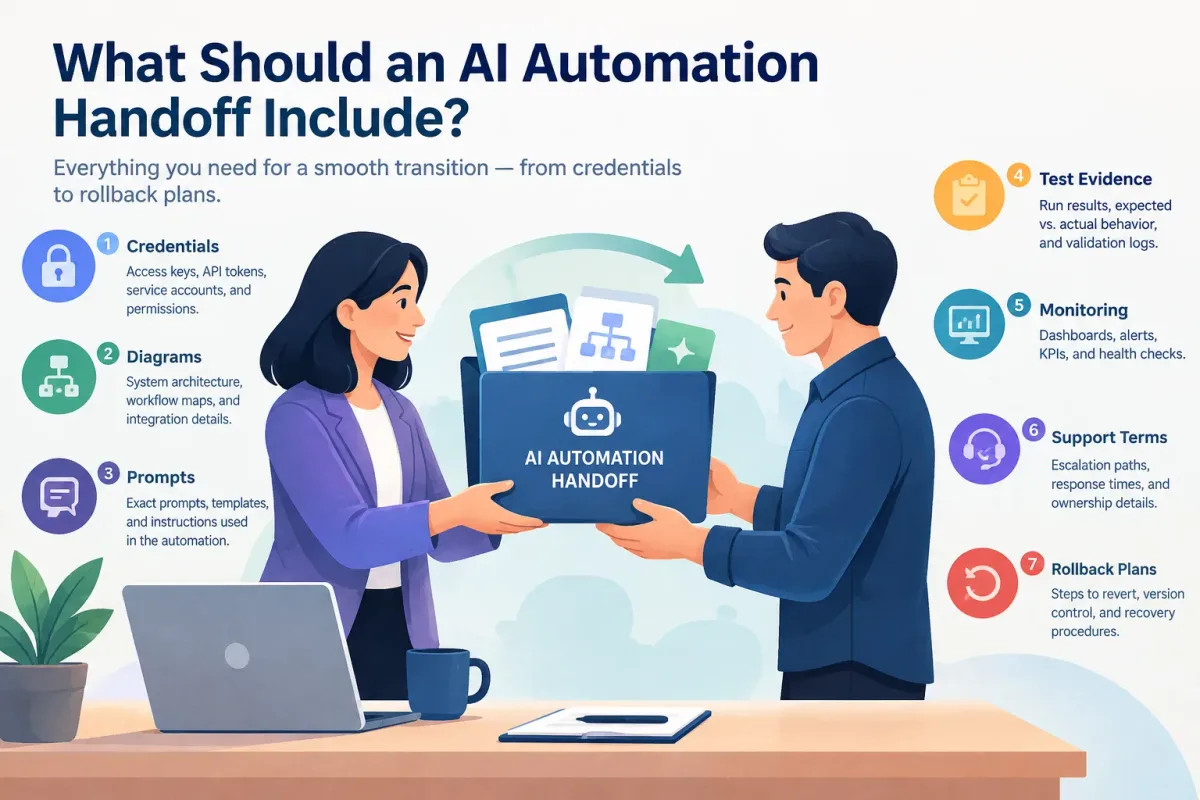
What Should an AI Automation Handoff Include?
Learn what a complete AI automation handoff includes: credentials, diagrams, prompts, test evidence, monitoring, support terms, and rollback plans.
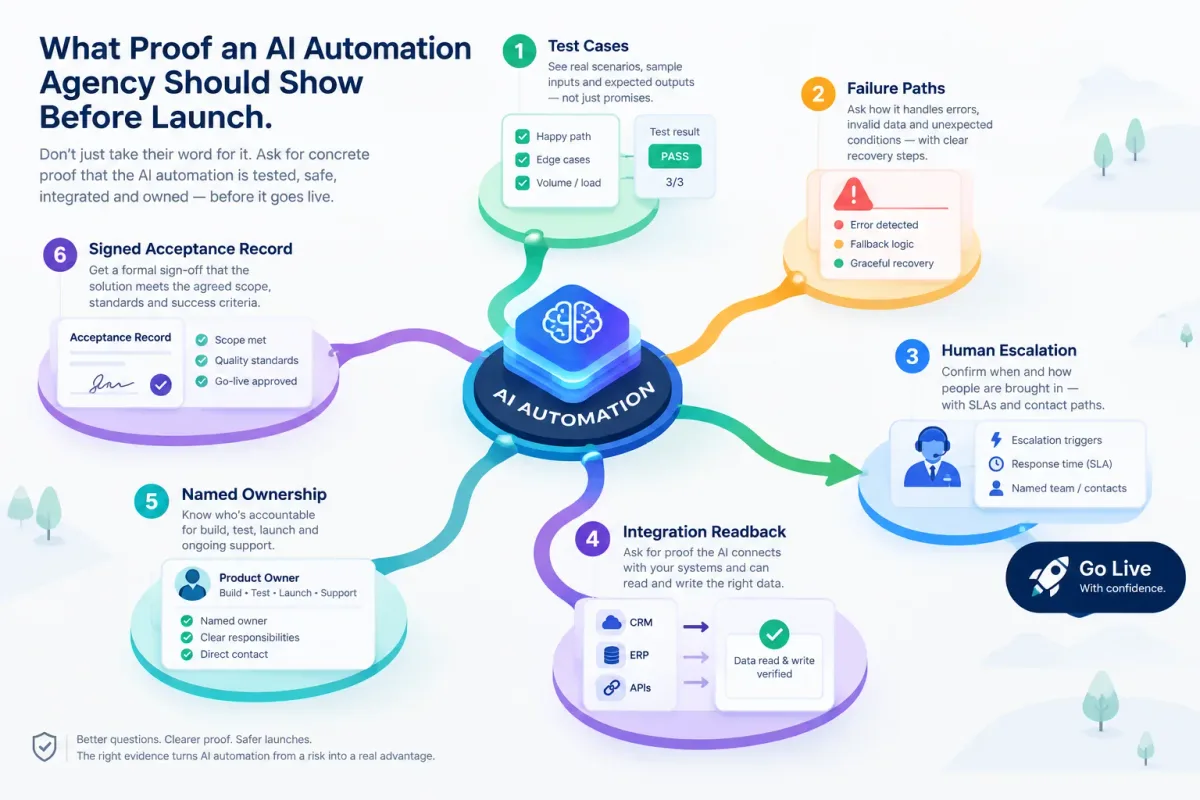
What Proof an AI Automation Agency Should Show Before Launch
Before an AI automation goes live, ask for test cases, failure paths, human escalation, integration readback, named ownership, and a signed acceptance record.
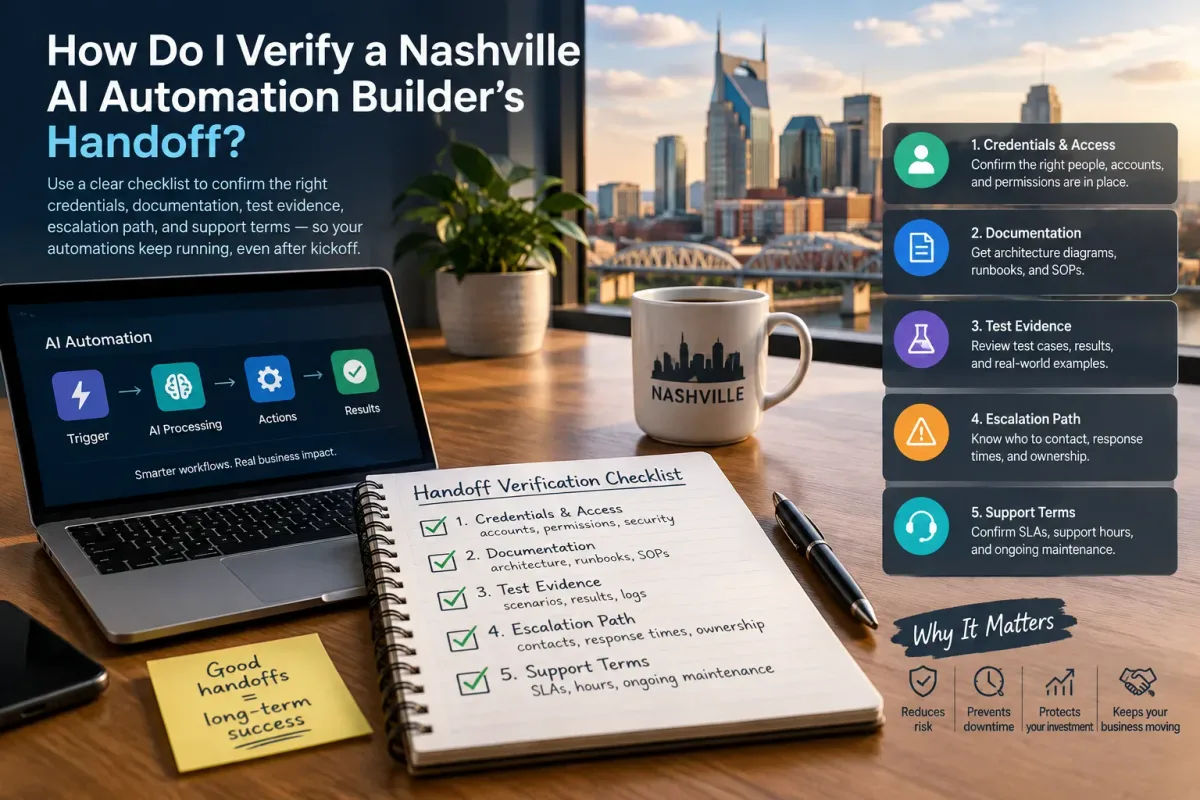
How Do I Verify a Nashville AI Automation Builder's Handoff?
Verify a Nashville AI automation builder's handoff with a checklist covering credentials, docs, test evidence, escalation, and support terms.