
Industry Insights
AI Upselling in Med Spas: How to Grow Revenue Per Visit
Most med spas capture less revenue per visit than they could. AI-driven upselling closes that gap by making the right offer easier to surface at the right.
The free 30-minute AI Operations Audit is a conversation about a normal week in your business and where the work piles up. We find the one change that would give you the most time back and send you a plain-English plan for it. No forms and no pitch.
Book a free AI audit
Patrick Gibbs
AI-driven upselling can create meaningful revenue upside for a mid-sized med spa by closing the gap between the revenue most practices currently capture per visit and what structured automated touchpoints can unlock. Manual upsell conversations happen in only a minority of appointments when left to staff discretion; AI-assisted prompting and follow-up sequences multiply those touchpoints without adding headcount. This guide breaks down exactly how AI upselling works across the pre-appointment, during-visit, and post-appointment windows, with worked examples and a practical implementation roadmap.
The Revenue Gap Most Med Spas Don’t Know They Have
Med spa revenue varies widely across the United States, even among practices with similar square footage and staff. The difference almost never comes down to marketing spend or location alone. It comes down to what happens before, during, and after each appointment.
Most med spas are running well below their potential revenue per client visit. A patient books a Botox appointment and leaves having spent exactly what they came in to spend: no add-on, no retail product, no rebooking incentive, no follow-up offer on a complementary service. This isn’t a failure of the injector or the front desk. It’s a systemic gap, one that AI is now uniquely positioned to close at scale.
Why Manual Upselling Fails Under Real Operating Conditions
Traditional upselling in med spas relies on three things: staff training, time availability, and consistency. All three break down under normal operating conditions. A skilled injector running back-to-back appointments doesn’t have the bandwidth to recall that a patient mentioned skin texture concerns last visit, cross-reference their treatment history, and craft a relevant recommendation, all while maintaining the flow of the current appointment. Front desk staff are juggling check-ins, phones, and payments simultaneously. The result is that upsell conversations happen when staff feel like it, when they remember, and when the schedule allows. That’s an inconsistency problem disguised as a training problem.
The pattern shows up in practice after practice: when upselling is left to manual processes, a complementary service or product gets discussed in only a minority of appointments. With structured AI-driven prompting and follow-up sequences, that share climbs sharply. That’s far more upsell touchpoints without adding a single team member.
The Math on Missed Opportunity
Illustrative example: if a practice enters its own monthly appointment count, average ticket, eligible-offer share, and average add-on value into a worksheet, the missed-opportunity estimate becomes: appointments x eligible-offer share x average add-on value. The point is not the exact number. The point is that small improvements in offer consistency can compound across clients who were already in the building.
Planning comparison to adapt with clinic-specific inputs:
| Metric | Manual Process | AI-Assisted Process |
|---|---|---|
| Monthly appointments | Your current baseline | Same traffic, better offer coverage |
| Upsell conversation rate | Dependent on staff memory and time | Prompted at planned touchpoints |
| Conversion of upsell offers | Tracked manually, if at all | Measured by service and offer type |
| Average upsell value | Current add-on average | Measured after offer logic improves |
| Monthly upsell revenue | Current add-on revenue | Appointments x accepted offers x add-on value |
| Annual upsell revenue | Current run rate | Monthly result x months measured |
Practices that also reduce cancellations with AI-powered reminders see even larger upside, since every kept appointment is another upsell opportunity. The gap shown above is only the modeled upside from the stated assumptions. It doesn’t account for rebooking rate improvements, retail attachment lift, or the compounding effect on client lifetime value from personalized follow-up communication.
How AI Upselling Actually Works Across the Client Journey
AI upselling isn’t a single tool. It’s a coordinated set of automated touchpoints spanning the full client lifecycle. The most effective implementations operate across three windows: pre-appointment, during-visit, and post-appointment. Each window has different mechanics and different ROI characteristics.
Pre-Appointment: The Booking Window
The period between booking and arrival is often underused. An AI system can analyze a client’s treatment history and upcoming appointment type, then send a personalized SMS or email that surfaces a contextually relevant add-on. For example: a patient booked for filler with a history of skin-care treatments might receive a message like, “Since you’re coming in Thursday, we have a few open slots for a hydration boost. Want to add it to the visit?” That message is triggered automatically, personalized to history, and requires zero staff involvement.
This works because it’s contextual, not promotional. In practice, pre-appointment personalized offers tend to convert far better than generic promotional blasts. The difference is relevance: a recommendation grounded in that patient’s specific record reads as a service, not a sales pitch.
During-Visit: Staff Prompting Without Replacing Clinical Judgment
AI at the point of care doesn’t mean a tablet replacing your injector. It means the practice management system surfacing a concise recommendation before the patient is called back. Something like: “Client history: filler + Botox, recent visit pattern, no recent retail purchases. Consider mentioning SPF or a brightening serum.” The staff member sees the prompt and decides whether the moment is right. AI removes the memory burden; humans retain judgment.
Post-Appointment: Where the Biggest Gap Exists
Most med spas send a satisfaction text after a visit, and then nothing. Our guide to post-treatment follow-up automation for med spas shows just how much revenue this communication gap costs. A patient effectively disappears into a void until they self-initiate their next booking. An AI-driven post-appointment sequence creates a structured, personalized communication arc that keeps the practice present without being intrusive:
- Immediate care message: Care instructions + a short check-in question about how they’re feeling
- Early education: Educational content on maximizing results (e.g., sun protection post-filler, skincare layering post-peel)
- Touch-up prompt: A soft invitation to book a touch-up or schedule a complementary service
- Cycle reminder: Personalized recommendation based on the clinic’s treatment-cycle guidance
- Loyalty offer: A bundle or return-visit offer tied to their specific service preferences
Each message is automated and triggered by appointment data. No manual calendar management, no staff reminders. The result is a client who feels genuinely attended to, and who is more likely to rebook than one who received a single post-visit text.
A Practical Framework for Building the AI Upsell Stack
Effective implementation doesn’t require replacing your existing systems. Most practices layer AI on top of what they already use. Here’s the framework for building a measurable upsell program without overhauling the practice management stack.
Step 1: Audit Your Data Quality First
AI recommendations are only as good as the data feeding them. Before anything else, verify that your practice management system has clean, consistent records for: treatment history by client, retail purchase history, appointment frequency, and contact opt-in status. If records are fragmented (services logged inconsistently, client profiles duplicated, phone numbers missing), clean them up before deploying any AI layer. Garbage in, irrelevant recommendations out.
Step 2: Build Your Upsell Opportunity Matrix
Not every service has the same upsell potential. Map each core service to its most logical add-ons, complementary treatments, and retail pairings. This matrix becomes the logic layer your AI draws from when generating recommendations.
| Primary Service | Top Add-Ons | Retail Pairings | Follow-Up Service |
|---|---|---|---|
| Botox | Brow lift, lip flip | SPF, peptide serum | Skincare consult, filler evaluation |
| Filler | Touch-up, microneedling | Hyaluronic serum, arnica gel | Botox refresh, HydraFacial |
| HydraFacial | LED therapy, booster add-on | Home care kit, vitamin C | Peel, laser treatment |
| Laser Resurfacing | Numbing upgrade, cryo cooling | Recovery serum, SPF 50 | Follow-up session, filler consult |
For an even more data-driven approach to the retail side, AI product recommendation automation for med spa retail takes this matrix concept further with clinical data integration. This matrix takes one working session with your clinical director to build. Once it exists, it runs the upsell logic engine indefinitely, and it should be reviewed quarterly as your service menu evolves.
Step 3: Define Your Integration Points
Identify exactly where in the client journey automated messages will fire. At minimum, a functional AI upsell system needs three integration points: a pre-appointment touchpoint before the visit (via SMS or email from your practice management platform), in-clinic prompting visible to front desk before check-in, and a post-appointment sequence based on treatment type. Tools that integrate cleanly with med spa software range from native CRM automations within platforms like Boulevard or Aesthetic Record to standalone AI communication assistants that sit on top of your existing booking system.
Step 4: Track the Metrics That Actually Matter
Don’t measure success by email open rates. The metrics that reveal real upsell ROI are:
- Average ticket value per visit: baseline vs. post-implementation trend
- Retail attachment rate: percentage of appointments resulting in a retail purchase
- Add-on conversion rate: offers surfaced vs. accepted
- Rebooking rate by treatment cycle: leading indicator of lifetime value
- Client retention rate: the compounding long-term metric
Review these on a recurring cadence. If add-on conversion is trending below your baseline goal, the recommendations may not be personalized enough. If rebooking is not improving by treatment cycle, the follow-up sequence needs tightening. These numbers tell you exactly where the system is leaking.
Three Mistakes That Sink AI Upselling Programs
Most implementations that underperform fail for the same reasons. The first is spray-and-pray personalization: sending the same offer to every client regardless of treatment history. A repeat filler patient doesn’t need an introductory consultation offer. Personalization isn’t a differentiator; it’s the baseline requirement for a recommendation to land as genuine rather than algorithmic.
The second mistake is over-automating the clinical conversation. AI should prompt and follow up; it should not substitute an injector’s judgment about whether a patient is a good candidate for a given procedure. The moment clients feel algorithmically pushed into treatments, trust erodes fast. Use AI to create the opportunity; use trained humans to close it responsibly and within clinical scope.
The third failure mode is deploying without a feedback loop. Upsell logic needs ongoing refinement. If a particular add-on pairing is being declined most of the time, that’s a signal: the pairing may be wrong, the timing off, or the offer structure needs adjustment. Set a recurring review cadence and treat the upsell matrix as a living document rather than a one-time configuration.
The Revenue Upside Is Real, But It Requires Discipline to Capture
A well-implemented AI upselling system in a mid-sized med spa can create meaningful incremental revenue. The upside comes from three compounding sources: increased average ticket per visit, improved retail attachment, and higher rebooking and retention rates driven by consistent post-appointment engagement.
The setup work is front-loaded: audit data, build the offer matrix, configure automations, and align staff on how to work alongside AI prompts. After that, the system runs largely on its own and improves as it accumulates more client interaction data.
For practices deciding where to start, the highest-ROI first move is often the post-appointment follow-up sequence. Most med spas have little structured communication beyond a satisfaction text. Adding a personalized sequence tied to treatment type creates a measurable rebooking lever without forcing the team to remember every follow-up manually. Start there, measure the delta, and expand from the results. If you’re ready to go deeper on the AI communication layer, from intake automation to multi-channel follow-up, firms like Epiphany Dynamics are building purpose-built solutions for the medical aesthetics space worth adding to your vendor evaluation.
Frequently Asked Questions
Q: What percentage of med spa revenue potential does the average practice actually capture per visit?
The average practice captures well below its potential revenue per client visit. The gap is not a service quality problem. It’s a systematic failure to surface relevant add-ons, complementary treatments, and retail recommendations at the right moments before, during, and after each appointment.
Q: What is the upsell conversation rate difference between manual and AI-assisted processes in med spas?
Manual upselling reaches only a minority of appointments when left to individual staff memory and bandwidth. With structured AI-driven prompting and post-appointment follow-up sequences, the share of appointments that get an upsell touchpoint climbs sharply, without adding a single team member. The difference is not effort; it’s consistency and timing.
Q: What is the highest-ROI first move in building an AI upsell system for a med spa?
The post-appointment follow-up sequence often delivers the clearest early signal because most med spas have little structured communication beyond a satisfaction text. Adding a personalized sequence tied to treatment type creates a measurable rebooking lever. Build and measure this before adding pre-appointment offers or in-clinic prompting.
Q: How long does it take to implement an AI upselling system in a med spa?
The setup work is front-loaded: audit data quality, build the service-to-add-on opportunity matrix, configure automations, and align staff on how to work alongside AI prompts. After that, the system runs largely on its own and improves as it accumulates more client interaction data. Practices that skip the data audit phase often struggle because the recommendations are only as good as the records behind them.
Q: What metrics should a med spa track to measure AI upselling system performance?
Track average ticket value per visit, retail attachment rate, add-on conversion rate, rebooking by treatment cycle, and client retention rate. Review trends against your baseline: if add-on conversion is not improving, personalization may be insufficient; if rebooking is flat, the follow-up sequence needs tightening.
Patrick Gibbs
AI Automation Expert
Patrick Gibbs helps professional practices implement AI automation that captures more leads, books more appointments, and scales without adding overhead. He's the founder of Epiphany Dynamics and creator of the AI Front Desk system.
Related Solutions
Build this into a real workflow
Related Posts
AI Admin Tools for Plumbers: What They Are and How to Choose
AI admin tools automate dispatch, reminders, invoicing follow-up, missed calls, and review requests for plumbers. What they do and how to choose.
Insurance Eligibility Automation for Physical Therapy Clinics
Eligibility automation for physical therapy clinics verifies benefits before the patient arrives, cuts front desk phone work, and can lower claim denial risk.
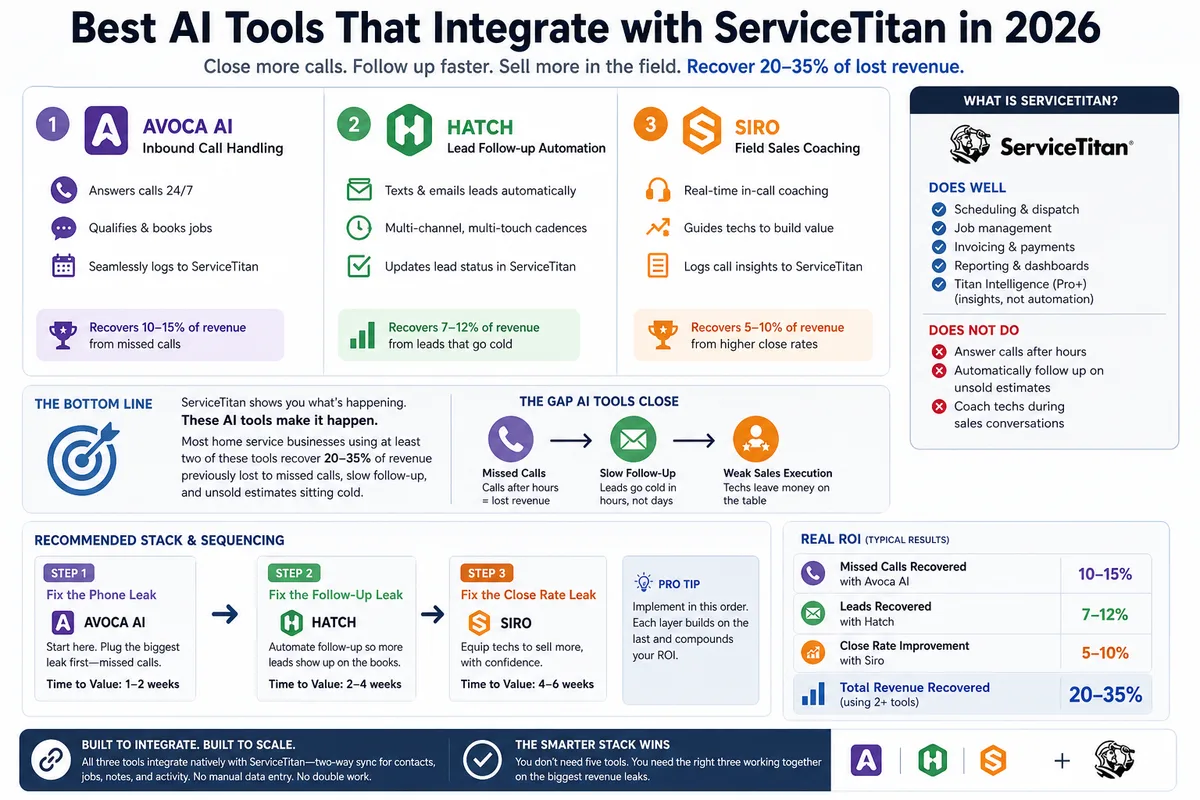
Best AI Tools That Integrate with ServiceTitan in 2026
Most ServiceTitan shops miss a meaningful share of inbound calls and leave most estimates unsold. These AI tools close those gaps inside ServiceTitan.