
Supply Chain
RPA in Supply Chain Management: Automating the Last Mile of Efficiency
Discover how robotic process automation is eliminating manual work across supply chain operations, from order processing to vendor management, creating faster.
The free 30-minute AI Operations Audit is a conversation about a normal week in your business and where the work piles up. We find the one change that would give you the most time back and send you a plain-English plan for it. No forms and no pitch.
Book a free AI audit
Patrick Gibbs
RPA in supply chain management deploys software bots to handle purchase orders, invoice matching, shipment tracking, and vendor scorecarding: the repetitive, rule-based work that currently consumes supply chain teams. Bots operate 24/7 with low error rates, process routine transactions faster than manual workflows, and free staff for exception management, supplier relationships, and strategic work.
The Supply Chain Automation Gap
Supply chains generate massive amounts of transactional work. Purchase orders need creation and confirmation. Shipments require tracking and exception management. Invoices demand matching and payment processing. Vendor performance needs monitoring and reporting.
Most of this work is still done manually, with humans copying data between systems, checking spreadsheets, sending emails, and updating records. The result: errors, delays, high costs, and burned-out employees.
Robotic Process Automation (RPA) offers a solution. The same principles driving AI-powered elimination of manual data entry across industries apply directly to supply chain operations. Software robots can perform repetitive, rule-based tasks 24/7 without errors, freeing humans for higher-value work that requires judgment and relationships.
What Is RPA in Supply Chain Context?
RPA uses software “bots” that mimic human interactions with digital systems. Unlike traditional integration that requires APIs and programming, bots work through the same interfaces humans use, clicking buttons, filling forms, copying data between applications.
Key Characteristics of Supply Chain RPA
| Characteristic | Description | Supply Chain Application |
|---|---|---|
| UI Automation | Bots interact with application interfaces | Data entry across ERP, WMS, TMS systems |
| Rule-Based | Follows explicit logic and conditions | Approval routing based on order value |
| Structured Data | Works with defined formats and fields | Invoice processing, order forms |
| High Volume | Economical for repetitive tasks | Processing thousands of orders daily |
| 24/7 Operation | No breaks, shifts, or fatigue | Continuous shipment tracking |
High-Impact RPA Use Cases in Supply Chain
Use Case 1: Order-to-Cash Automation
The Manual Process: A customer order arrives via email. A customer service representative:
- Opens the email and extracts order details
- Logs into ERP system
- Checks product availability
- Enters order information manually
- Generates order confirmation
- Sends confirmation to customer
- Creates shipping request
- Updates order status throughout fulfillment
- Generates and sends invoice
- Processes payment and updates records
Time per order: Manual and variable Error rate: Frequent manual errors Processing hours: Limited to business hours
The RPA Solution:
An integrated bot workflow:
-
Order Intake Bot
- Monitors email inbox for orders
- Extracts data from PDFs, Excel files, or email text
- Validates data completeness
- Creates structured order record
-
Availability Check Bot
- Queries ERP inventory in real-time
- Checks ATP (available-to-promise) quantities
- Identifies potential stockouts
- Flags orders requiring attention
-
Order Entry Bot
- Enters order into ERP system
- Creates customer record if new
- Applies pricing rules and discounts
- Generates order confirmation
-
Fulfillment Coordination Bot
- Creates pick tickets in WMS
- Schedules shipments with carriers
- Generates shipping labels
- Updates customer with tracking
-
Invoice and Payment Bot
- Generates invoice upon shipment
- Sends to customer via preferred channel
- Monitors payment status
- Applies cash receipts
- Handles exceptions and follow-up
Results:
- Processing time: Faster routine processing once rules and source data are stable
- Error rate: Low when rules and source data are clean
- Availability: 24/7 processing
- Capacity: Higher routine volume without matching staff growth
Use Case 2: Purchase-to-Pay Automation
The Challenge: Procurement involves complex workflows across multiple systems and stakeholders. POs must match requisitions, invoices must match POs and receipts, and approvals must follow organizational hierarchies.
RPA Implementation:
| Process Step | Manual Effort | RPA Automation |
|---|---|---|
| Requisition Processing | 10 min per req | Auto-route for approval, create PO |
| PO Creation | 15 min per PO | Generate from approved requisitions |
| Vendor Confirmation | 20 min per order | Auto-send, track responses, update status |
| Receipt Matching | 10 min per receipt | Match to PO, flag discrepancies |
| Invoice Processing | 20 min per invoice | Three-way match, route exceptions |
| Payment Processing | 15 min per batch | Prepare payment runs, apply cash |
Advanced Capabilities:
- Exception Handling: Automatically route mismatches to appropriate approvers
- Vendor Communication: Send proactive updates on order status
- Early Payment Capture: Identify and process discounts for early payment
- Spend Analytics: Aggregate data for vendor performance and spend visibility
Results:
- Large reduction in processing time
- Meaningful decrease in invoice processing costs
- Near-elimination of late payment penalties
- Improved vendor relationships through timely communication
Use Case 3: Inventory and Warehouse Management
The Manual Burden: Warehouse operations generate constant data entry: receiving records, put-away confirmations, pick confirmations, cycle counts, and adjustments.
RPA Applications:
Receiving Automation:
- Extract ASN (advance shipping notice) data
- Create receiving appointments
- Generate receiving documentation
- Update inventory upon receipt
- Flag discrepancies for inspection
Cycle Count Automation:
- Generate count schedules based on ABC classification
- Distribute count lists to warehouse staff
- Collect count results via mobile devices
- Post adjustments to inventory
- Generate variance reports
Replenishment Automation:
- Monitor pick face inventory levels
- Generate replenishment tasks when thresholds hit
- Prioritize based on upcoming demand
- Confirm completion and update locations
Results:
- Fewer inventory record errors
- Better inventory accuracy
- Fewer stockout incidents
- Significant reduction in expediting costs
Use Case 4: Shipment Tracking and Exception Management
The Visibility Challenge: Shipments move through multiple carriers and systems. Tracking requires checking carrier websites, updating internal systems, and managing exceptions when things go wrong.
RPA Implementation:
Proactive Tracking Bot:
- Query carrier APIs or websites for shipment status
- Update internal TMS with current location
- Calculate estimated arrival times
- Send proactive notifications to customers
- Flag shipments at risk of delay
Exception Management Bot:
- Identify shipments missing milestones
- Research cause of delay
- Notify affected customers with updated ETAs
- Escalate critical shipments to operations team
- Generate carrier performance reports
Claims Processing Bot:
- Identify damaged or lost shipments
- Gather required documentation
- File claims with carriers
- Track claim status
- Record recoveries
Results:
- More complete shipment visibility than manual tracking
- Fewer “where is my order” inquiries
- Better on-time delivery performance
- Lower freight costs through better visibility
Use Case 5: Vendor and Supplier Management
The Coordination Burden: Managing hundreds or thousands of suppliers requires constant communication: onboarding, scorecarding, issue resolution, and relationship maintenance.
RPA Applications:
Vendor Onboarding:
- Collect and validate required documentation
- Check credit and references
- Set up vendor master records
- Communicate requirements and expectations
- Schedule onboarding calls
Performance Scorecarding:
- Extract performance data from multiple systems
- Calculate KPIs (on-time delivery, quality, responsiveness)
- Generate scorecards and distribute to vendors
- Flag underperformers for review
- Track improvement initiatives
Supplier Communication:
- Send PO acknowledgments and confirmations
- Request updated capacity and lead time information
- Communicate forecast changes
- Coordinate new product introductions
- Manage contract renewals
Results:
- Meaningful reduction in vendor management administrative time
- Improved supplier performance through consistent communication
- Faster new vendor onboarding
- Better supplier relationships through proactive engagement
RPA Technology Options
Enterprise RPA Platforms
| Platform | Strengths | Best For |
|---|---|---|
| UiPath | Comprehensive platform, strong partner network | Large enterprises with complex needs |
| Automation Anywhere | Cloud-native, AI integration | Organizations wanting cloud deployment |
| Blue Prism | Security, enterprise governance | Highly regulated industries |
| Microsoft Power Automate | Microsoft integration, cost-effective | Microsoft-centric organizations |
Specialized Supply Chain Automation
| Solution | Focus | Consideration |
|---|---|---|
| SAP IRPA | SAP system integration | Best for SAP-centric environments |
| Oracle RPA | Oracle Cloud integration | Complements Oracle SCM |
| Supply Chain RPA Specialists | Industry-specific bots | Faster implementation for standard processes |
Implementation Framework
Phase 1: Process Assessment
Process Identification:
- Map all supply chain processes
- Identify high-volume, rule-based activities
- Quantify time and cost of manual execution
- Prioritize by automation potential and business impact
Feasibility Analysis: For each candidate process, evaluate:
- Process stability (frequency of changes)
- Data availability and quality
- System integration requirements
- Exception frequency and complexity
- Compliance and audit requirements
Business Case Development:
- Calculate current process costs
- Estimate automation costs (licensing, development, maintenance)
- Project efficiency gains and error reduction
- Determine ROI and payback period
Phase 2: Pilot Implementation
Bot Development:
- Select pilot process (high volume, low complexity)
- Document process steps in detail
- Configure bot workflow
- Handle system authentication and security
- Develop exception handling logic
Testing and Validation:
- Execute test cases covering normal and exception scenarios
- Validate output accuracy
- Measure processing time and throughput
- Conduct user acceptance testing
Deployment:
- Migrate to production environment
- Implement monitoring and alerting
- Train operations team on bot management
- Establish support procedures
Phase 3: Scale and Optimize
Process Expansion:
- Add additional processes based on priority list
- Use reusable components from pilot
- Implement cross-process workflows
- Develop bot library for common tasks
Advanced Capabilities:
- Integrate AI for document understanding
- Implement cognitive automation for semi-structured data
- Add analytics for process optimization
- Deploy attended bots for human-bot collaboration
Phase 4: Center of Excellence (Ongoing)
Governance Structure:
- Establish RPA Center of Excellence
- Define standards and best practices
- Manage bot lifecycle and versioning
- Coordinate with IT on infrastructure
Continuous Improvement:
- Monitor bot performance and utilization
- Optimize bot efficiency
- Retire and replace underperforming automations
- Identify new automation opportunities
Measuring RPA Success
Operational Metrics
| Metric | Calculation | Target |
|---|---|---|
| Automation Rate | Automated transactions / Total transactions | High routine-task coverage |
| Processing Time Reduction | (Before - After) / Before | Large improvement |
| Error Rate | Failed transactions / Total transactions | Low failure rate |
| Bot Utilization | Active bot hours / Available hours | Strong utilization |
Financial Metrics
| Metric | Calculation | Typical Impact |
|---|---|---|
| Cost per Transaction | Total cost / Transaction volume | Meaningful reduction |
| Labor Hours Saved | Hours freed from automation | FTE capacity increase |
| Error Cost Avoidance | Errors prevented x Cost per error | Significant quality savings |
| ROI | (Benefits - Costs) / Costs | Strong when process volume is high |
Business Impact Metrics
| Metric | Measurement | Target |
|---|---|---|
| Cycle Time | End-to-end process duration | Meaningful reduction |
| Customer Satisfaction | Survey scores | Improvement |
| Employee Satisfaction | Engagement surveys | Reduction in tedious work |
| Compliance | Audit findings | Near-zero errors |
Common Challenges and Solutions
System Changes Break Bots
Challenge: When applications update, bots often fail because they can’t find the UI elements they expect.
Solutions:
- Use API-based automation where possible (more stable than UI)
- Implement solid error handling and recovery
- Maintain test environments for bot validation
- Establish change management procedures between IT and RPA teams
Process Variability
Challenge: Real-world processes have more exceptions and variations than initially documented.
Solutions:
- Thorough process mining before automation
- Design for exception handling from the start
- Implement human-in-the-loop for complex cases
- Continuous monitoring and bot refinement
Scaling Difficulties
Challenge: Bots that work in pilot fail to scale to production volumes.
Solutions:
- Load testing before production deployment
- Proper infrastructure sizing
- Queue management for high-volume processes
- Gradual scaling rather than big-bang deployment
The Future of Supply Chain Automation
RPA is evolving toward more intelligent automation:
- Cognitive Automation: Combining RPA with AI for document understanding and decision-making
- Process Mining: Automatically discovering and optimizing processes before automation
- Hyperautomation: Integrating RPA with low-code development, AI, and process mining
- Autonomous Supply Chain: Self-healing systems that detect and resolve issues without human intervention
Conclusion
For predictive approaches to maintenance and quality, predictive analytics in manufacturing covers the complementary capabilities. RPA isn’t just about cost reduction; it’s about enabling supply chain teams to focus on strategic value rather than transactional work. By automating routine tasks, organizations improve speed, accuracy, and scalability while freeing humans for the judgment, relationships, and innovation that drive competitive advantage.
The supply chains of the future will be largely autonomous, with humans focused on exception management, continuous improvement, and strategic supplier relationships. RPA is the foundation of that transformation.
Your supply chain is generating work that bots could handle. For the inventory side specifically, our guide to automated inventory management covers AI-powered demand forecasting and replenishment. The question is how quickly you’ll deploy them.
Frequently Asked Questions
Q: What supply chain processes are best suited for RPA automation?
The highest-value RPA candidates in supply chain are invoice processing and three-way matching, purchase order creation and confirmation, shipment tracking and exception management, and vendor scorecarding. These processes share the key RPA-friendly characteristics: they’re high volume, rule-based, involve structured data moving between digital systems, and currently consume significant staff hours with no judgment required. Avoid automating processes with high exception rates or frequent rule changes until you have more mature RPA capabilities in place.
Q: How much can RPA reduce supply chain processing costs?
Supply chain teams implementing RPA for invoice processing and order management often report major reductions in processing time and cost per transaction. One key driver is error elimination: manual data entry mistakes drop sharply when rules are clear and source data is clean, avoiding the costly rework and supplier relationship damage those errors cause. Full-year ROI is strongest for well-selected supply chain automation targets with high transaction volume and stable rules.
Q: What happens to supply chain RPA bots when the software they interact with changes?
UI-based bots break when application interfaces update, which is the most common challenge in RPA maintenance. Mitigation strategies include using API-based integration where available (far more stable than UI scraping), maintaining test environments that mirror production, and establishing formal change management processes between IT and RPA teams so application updates don’t blindside automation. Plan for a recurring maintenance budget rather than treating bot deployment as a one-time project.
Q: What is the difference between RPA and AI-powered supply chain automation?
Traditional RPA follows rigid rules and requires structured, predictable inputs: it cannot handle variability or make judgment calls. AI-powered automation adds the ability to understand unstructured documents (like non-standard vendor invoices), extract meaning from text, and make conditional decisions based on content rather than just format. Most effective supply chain automation combines both: RPA handles the routine execution while AI handles document understanding and exception triage. The combination is often called intelligent process automation or cognitive automation.
Q: How long does a typical supply chain RPA implementation take?
A focused pilot should cover one stable process, such as purchase order creation or invoice matching, and move to production only after requirements, exceptions, test cases, monitoring, and support ownership are clear. Full-scale implementations take longer because each additional process adds integration, exception handling, and change-management work. The most time-consuming phase is process documentation before development begins: bots can only automate what is fully mapped, and discovering undocumented exceptions during development is the primary cause of delays and cost overruns in RPA projects.
Patrick Gibbs
AI Automation Expert
Patrick Gibbs helps professional practices implement AI automation that captures more leads, books more appointments, and scales without adding overhead. He's the founder of Epiphany Dynamics and creator of the AI Front Desk system.
Related Solutions
Build this into a real workflow
Related Posts
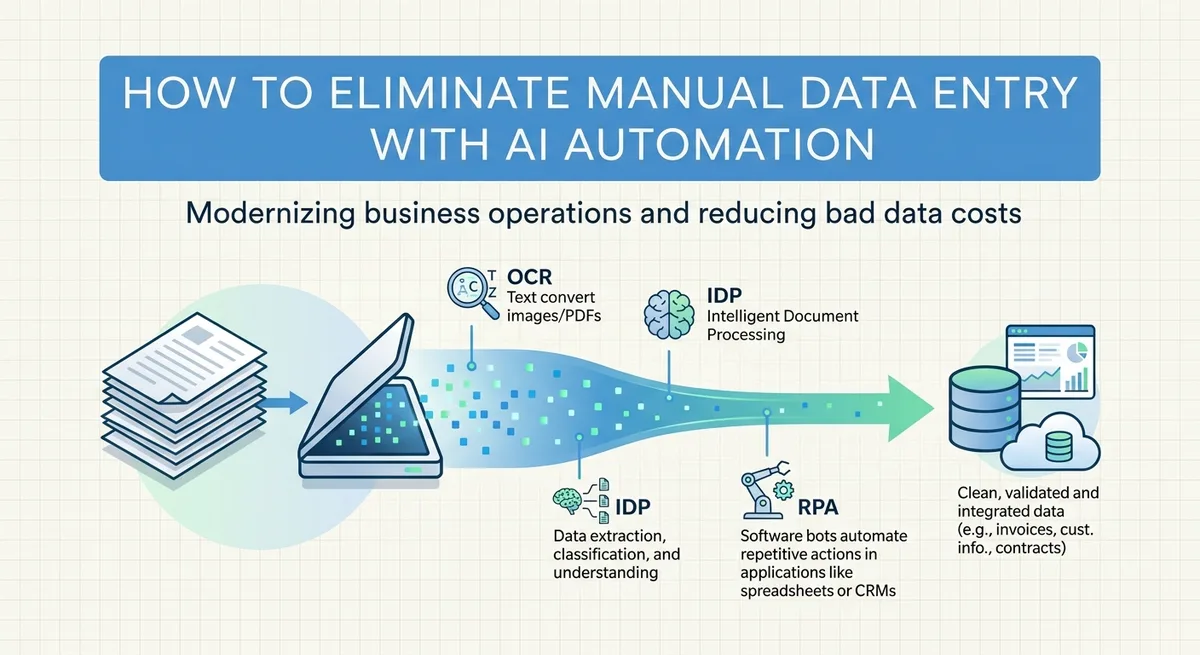
How to Eliminate Manual Data Entry With AI Automation
Manual data entry drains staff time and creates bad data. Here's how AI automation removes the bottleneck and how to choose the right starting workflow.

Automated Inventory Management: The End of Stockouts and Overstock
Learn how AI-powered inventory management systems reduce stockout risk, lower carrying-cost pressure, and optimize stock levels across large SKU catalogs with.

AI Workflow Automation for Small Business: A Complete Implementation Guide
Discover how small businesses can use AI workflow automation to eliminate repetitive tasks, reduce costs, and compete with larger enterprises without.