
Business Growth
AI Automation Solutions for Driving Revenue Growth
Discover how AI automation solutions can support revenue growth for your business. Learn practical applications, actionable insights, and a step-by-step.
The free 30-minute AI Operations Audit is a conversation about a normal week in your business and where the work piles up. We find the one change that would give you the most time back and send you a plain-English plan for it. No forms and no pitch.
Book a free AI audit
Patrick Gibbs
AI automation solutions support revenue growth by eliminating the administrative overhead that prevents businesses from capturing and converting more customers: chatbots routing routine questions, predictive personalization improving relevance, and automated follow-up sequences reviving leads that would otherwise go cold. These tools are no longer enterprise-only: SMBs can deploy practical AI automation in sales, customer service, and operations without hiring a new team for every repetitive workflow. This article provides a prioritization framework and specific examples across each revenue-generating category.
The Untapped Potential of AI Automation for Revenue Growth
In modern rapidly evolving business landscape, companies are constantly seeking innovative strategies to stay ahead of the competition and drive revenue growth. While many organizations have explored various avenues, one area that holds immense potential but often remains underutilized is AI automation. Artificial intelligence (AI) is no longer a futuristic concept; it’s a present-day reality that can be used to streamline operations, enhance customer experiences, and ultimately, generate significant revenue increases.
Many business owners mistakenly believe that AI implementation requires extensive technical expertise and exorbitant investments. However, the reality is that AI automation solutions are becoming increasingly accessible and affordable, even for small and medium-sized enterprises (SMEs). By applying AI to specific business processes, organizations can reduce manual work, respond faster, and improve revenue capture. For a practical starting point, our guide on improving close rates with AI automation shows how speed-to-lead affects conversion.
This article delves into the practical applications of AI automation for driving revenue growth. We’ll explore specific examples, provide actionable insights, and offer a framework for businesses to identify and implement AI-powered solutions that align with their unique needs and objectives. The practical goal is simple: identify where automation can protect revenue that is already being lost to slow response, manual follow-up, or inconsistent handoffs.
Identifying Revenue-Generating Opportunities with AI
The first step in using AI for revenue growth is to identify the areas within your business that can benefit most from automation. This requires a thorough assessment of your current processes, identifying bottlenecks, inefficiencies, and opportunities for improvement. Consider the following areas:
- Sales and Marketing: Lead generation, customer segmentation, personalized marketing campaigns, sales forecasting.
- Customer Service: Chatbots, automated email responses, personalized support experiences, proactive issue resolution.
- Operations: Process automation, supply chain optimization, inventory management, predictive maintenance.
- Product Development: AI-powered research, automated testing, personalized product recommendations.
Once you’ve identified potential areas for improvement, prioritize them based on their potential impact on revenue. Consider the following factors:
- Revenue Potential: How much additional revenue can be generated by automating this process?
- Cost Savings: How much can be saved by reducing manual labor or improving efficiency?
- Customer Satisfaction: How will this automation improve the customer experience and drive loyalty?
- Implementation Feasibility: How easy is it to implement an AI solution for this process?
To illustrate, consider a hypothetical e-commerce business. They analyze their operations and find that a meaningful share of customer service inquiries are repetitive and easily answered with approved responses. Implementing an AI-powered chatbot to handle these inquiries could free up customer service representatives to focus on more complex issues, improve response times, and increase customer satisfaction. Our roundup of the best AI tools for service companies covers which platforms are worth evaluating in this category. This, in turn, could lead to increased sales and repeat business.
Practical AI Automation Solutions and Their Revenue Impact
Now, let’s explore some specific AI automation solutions and their potential impact on revenue:
AI-Powered Chatbots for Enhanced Customer Service and Sales
AI chatbots can support customer service by answering common questions and routing requests after hours. They can answer frequently asked questions, resolve simple issues, and even guide customers through the sales process. This not only improves customer satisfaction but also frees up human agents to focus on more complex issues, ultimately increasing revenue.
Example: A company implements an AI chatbot on its website to answer routine questions, route complex requests, and surface relevant product recommendations based on browsing history. The useful measurement is not a borrowed benchmark. It is the company’s own before-and-after data: support workload, lead capture, assisted conversions, average order value, and customer satisfaction.
On a related note, see Will AI Replace Customer Service? The Honest Answer in 2026.
AI-Driven Personalized Marketing for Increased Conversion Rates
AI can analyze vast amounts of customer data to create highly personalized marketing campaigns that resonate with individual customers. This can lead to increased engagement, higher conversion rates, and ultimately, more revenue. AI can be used to personalize email marketing, website content, product recommendations, and even ad targeting.
Example: An online retailer uses AI to segment its customer base based on demographics, purchase history, and browsing behavior. They then create personalized email campaigns designed for each segment. Customers who have previously purchased running shoes receive emails about new running shoe models and upcoming running events. The team measures whether the personalized approach improves opens, clicks, repeat purchases, and attributed sales compared with generic broadcasts.
AI-Enabled Sales Forecasting for Optimized Inventory Management
Accurate sales forecasting is crucial for optimizing inventory management and avoiding stockouts or overstocking. AI can analyze historical sales data, market trends, and other relevant factors to predict future demand with greater accuracy than traditional forecasting methods. This allows businesses to optimize their inventory levels, reduce waste, and maximize revenue.
Example: A manufacturing company implements an AI-powered sales forecasting system that analyzes historical sales data, weather patterns, and economic indicators to predict demand for its products. The team measures forecast accuracy, inventory carrying cost, stockout frequency, and sales lost to unavailable products before and after rollout.
AI for Pricing Optimization
AI algorithms can dynamically adjust pricing based on real-time market conditions, competitor pricing, and customer demand. This allows businesses to maximize revenue by charging the optimal price for each product at any given time.
Example: An airline utilizes AI-powered dynamic pricing to adjust ticket prices based on demand, time of day, and competitor pricing. The revenue question is whether the model improves yield without damaging conversion, trust, or long-term customer value.
Building an AI Automation Strategy: A Step-by-Step Framework
Implementing AI automation effectively requires a well-defined strategy. Here’s a step-by-step framework to guide you through the process:
- Assess Your Needs: Identify the areas within your business that can benefit most from AI automation, as discussed earlier.
- Define Your Goals: Clearly define what you want to achieve with AI automation. Do you want to increase sales, reduce costs, improve customer satisfaction, or all of the above?
- Choose the Right Solutions: Research and select AI automation solutions that align with your needs and goals. Consider factors such as cost, ease of implementation, and integration with existing systems. Our AI automation cost and pricing guide breaks down what different categories of automation actually cost across all tiers. For Epiphany Dynamics service pricing, see the pricing page.
- Pilot Project: Start with a pilot project to test the effectiveness of the chosen AI solution in a controlled environment. This allows you to identify any potential issues and make adjustments before rolling out the solution company-wide.
- Implementation and Integration: Implement the AI solution and integrate it with your existing systems. Ensure that your employees are properly trained on how to use the new system.
- Monitor and Optimize: Continuously monitor the performance of the AI solution and make adjustments as needed to optimize its effectiveness. Track key metrics such as sales, costs, and customer satisfaction.
ROI Calculation: Use your own numbers instead of a vendor example. The formula is (measured revenue lift + measured cost savings - total automation cost) / total automation cost. Revenue lift should come from tracked sales, recovered leads, larger order values, or retained customers. Costs should include platform subscriptions, implementation time, training, and ongoing maintenance.
Overcoming Challenges and Ensuring Successful AI Implementation
While AI automation offers tremendous potential, it’s important to be aware of the challenges that can arise during implementation. Here are some common challenges and how to overcome them:
- Data Quality: AI algorithms rely on high-quality data to function effectively. Ensure that your data is accurate, complete, and consistent.
- Lack of Expertise: Implementing and managing AI solutions requires specialized expertise. Consider hiring AI specialists or partnering with a reputable AI vendor.
- Integration Issues: Integrating AI solutions with existing systems can be complex and challenging. Choose solutions that are compatible with your current infrastructure and have solid integration capabilities.
- Employee Resistance: Some employees may resist AI automation due to fear of job displacement. Communicate the benefits of AI automation clearly and involve employees in the implementation process.
- Ethical Considerations: AI can raise ethical concerns, such as bias and privacy. Ensure that your AI solutions are used responsibly and ethically.
To mitigate these challenges, it’s crucial to invest in proper data governance, provide adequate training for employees, and establish clear ethical guidelines for AI usage.
Future Trends in AI Automation and Revenue Generation
The field of AI is constantly evolving, and new advancements are emerging all the time. Here are some key trends to watch out for:
- Generative AI: Generative AI models, such as those used to create text, images, and code, are becoming increasingly powerful and accessible. These models can be used to automate content creation, design marketing materials, and even develop new products.
- Edge AI: Edge AI involves running AI algorithms on devices at the edge of the network, rather than in the cloud. This can reduce latency, improve security, and enable new applications in areas such as manufacturing and transportation.
- Explainable AI (XAI): XAI aims to make AI algorithms more transparent and understandable. This is particularly important in industries such as healthcare and finance, where it’s crucial to understand how AI systems are making decisions.
- Hyperautomation: Hyperautomation involves automating as many business processes as possible, using a combination of AI, robotic process automation (RPA), and other technologies. This can lead to significant efficiency gains and cost savings.
By staying abreast of these trends, businesses can position themselves to take advantage of the latest AI innovations and drive even greater revenue growth.
Conclusion: Embracing AI for Sustainable Revenue Growth
AI automation is no longer a futuristic concept but a powerful tool that businesses can use today to drive revenue growth. By identifying revenue-generating opportunities, implementing practical AI solutions, and building a well-defined AI strategy, organizations can unlock significant benefits, including increased sales, reduced costs, and improved customer satisfaction. While challenges may arise during implementation, they can be overcome with careful planning, proper data governance, and adequate training. The future of business is undoubtedly intertwined with AI, and those who embrace this technology will be best positioned to thrive in the years to come. As you explore AI solutions, consider how a partner with deep expertise and a comprehensive understanding of business processes can accelerate your journey and maximize your ROI. For example, companies like Epiphany Dynamics provide customized solutions designed to help businesses like yours unlock the transformative power of AI.
Ready to drive revenue growth with AI automation? Book a consultation with Epiphany Dynamics to identify the highest-ROI automation opportunities in your business. We serve businesses across industries including med spas, dental practices, HVAC, legal, and home services. Browse our AI automation tools and implementation guides to get started.
Frequently Asked Questions
Q: Which AI automation solutions have the highest ROI for driving revenue growth?
AI chatbots for customer service and sales, personalized email marketing automation, and AI-powered sales forecasting are often strong candidates because they touch revenue or capacity directly. A chatbot that handles routine customer inquiries can reduce service workload while always-on availability captures leads that would otherwise be lost. Personalized email campaigns using AI segmentation can outperform generic broadcasts when the targeting and offer are actually relevant.
Q: How long does it take to see revenue results from AI automation?
Simple automations like chatbots and email sequences usually produce usable measurement faster than complex implementations such as AI-driven pricing optimization. The pilot project approach, testing one automation before scaling, gives you a practical proof point without risking full deployment on unvalidated assumptions.
Q: What is the biggest mistake businesses make when implementing AI automation for revenue growth?
The most common mistake is automating a broken process rather than a working one. AI amplifies your existing system: if your sales follow-up process is inconsistent, AI-powered follow-up will be inconsistently wrong at scale. Before automating, document the current process, identify what works and what does not, and fix the fundamental workflow first. AI is most powerful when it is accelerating a process that already produces results.
Q: How do you calculate ROI for an AI automation investment?
The formula is: measured benefits minus total costs, divided by total costs. Benefits include increased revenue tracked from AI-influenced sales, cost savings from reduced labor hours, and efficiency gains. Costs include platform subscriptions, implementation time, training, and ongoing maintenance. Use your own baseline and post-launch data rather than a generic benchmark.
Patrick Gibbs
AI Automation Expert
Patrick Gibbs helps professional practices implement AI automation that captures more leads, books more appointments, and scales without adding overhead. He's the founder of Epiphany Dynamics and creator of the AI Front Desk system.
Related Solutions
Build this into a real workflow
Related Posts
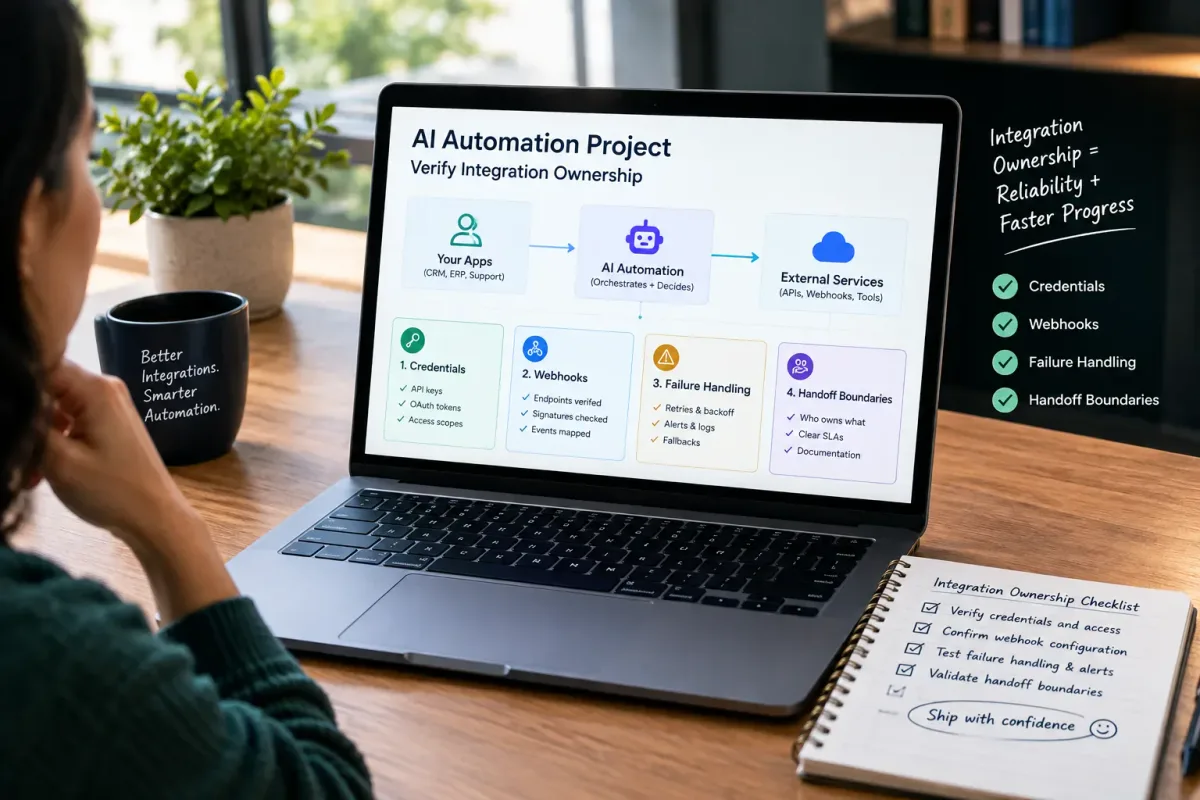
How Do I Verify Integration Ownership in an AI Automation Project?
Learn how to verify integration ownership in an AI automation project, including credentials, webhooks, failure handling, and handoff boundaries.

Is Epiphany Dynamics Legitimate for AI Automation?
Is Epiphany Dynamics legitimate for AI automation? Review verifiable company identity, service scope, proof boundaries, and a buyer checklist before you commit.
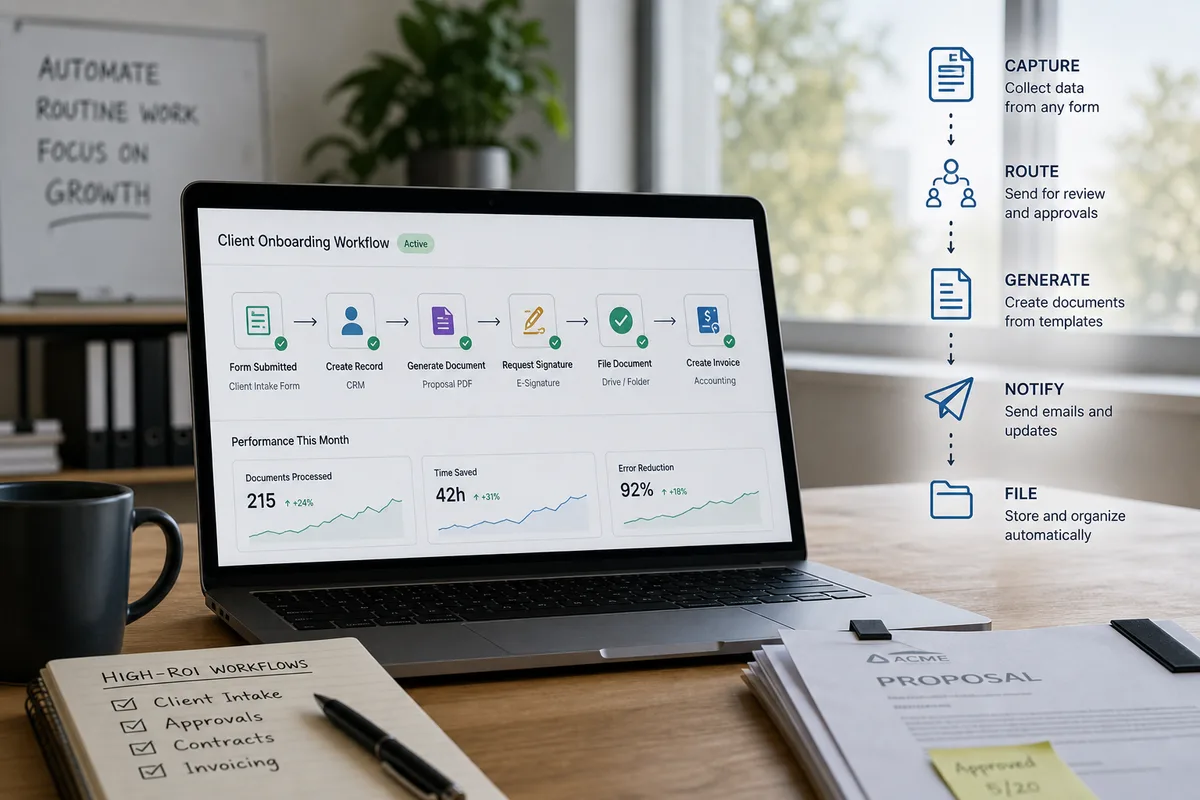
Document Workflow Automation for Small Business (2026 Guide)
Small businesses spend a substantial share of employee time on document tasks. Here's how document workflow automation works, which workflows to build first.