
Industry Insights
AI Replacing Receptionists: The 2026 Reality Check for Businesses
Is AI replacing receptionists? Explore the real benefits, limitations, and what the future holds for front desk roles in 2026.
The free 30-minute AI Operations Audit is a conversation about a normal week in your business and where the work piles up. We find the one change that would give you the most time back and send you a plain-English plan for it. No forms and no pitch.
Book a free AI audit
Patrick Gibbs
AI receptionists can handle routine calls and scheduling outside staffed hours. Their fit depends on the questions callers ask, the systems they must update, and the quality of the human handoff. Compare the total cost of reliable coverage; a lower software bill alone does not establish equivalent service or justify replacing a staff role.
AI Replacing Receptionists: What the Data Actually Shows
The useful question is which reception tasks your business can automate reliably. This article is a workflow assessment, not a claim about hundreds of client deployments. Test routine call handling separately from judgment, physical duties and relationships.
Understanding where AI excels and where humans remain irreplaceable helps businesses make smart decisions about their reception needs. The goal isn’t to eliminate jobs blindly: it’s to create more efficient operations where technology handles routine tasks and humans focus on what they do best.
The Case for AI Receptionists: Real Benefits
Cost Efficiency at Scale
Compare your actual receptionist payroll, benefits, coverage hours and duties with the setup, usage, support and review costs of an AI receptionist build. A free audit identifies the calls worth automating and gives you a clear starting point. Work that requires physical presence or a person’s judgment stays in the staffing plan.
For a business operating on thin margins, include supervision and failure recovery in the comparison. Recovered time may create capacity, but it does not become cash savings unless actual spending changes.
24/7 Availability Without Burnout
Staff coverage follows a schedule. An automated assistant can be configured for additional hours, subject to provider availability, system limits and a tested fallback. It still needs an accountable operator and access to human help.
Test the intended after-hours coverage separately from daytime calls. Measure resolution and handoff quality when staff are unavailable, especially for urgent requests.
A large share of service inquiries arrive outside traditional business hours. Companies relying solely on human receptionists miss those opportunities simply because no one is there to answer. The cost of those missed calls compounds far beyond the immediate lost revenue.
Consistency in Every Interaction
A configured assistant can use a standard greeting and qualification checklist. That does not guarantee compliance on every call. Review recordings or transcripts, test unusual requests and route uncertainty to a person.
Measure missing information, incorrect answers and failed handoffs alongside response time. Standardization is useful only when the interaction remains accurate and the caller can reach help.
Instant Response Times
The speed-to-lead guide provides background for examining response delays. Measure your actual answer time, abandonment and successful handoffs; do not assume a fixed response speed or conversion gain.
Concurrent capacity depends on telephony limits, provider quotas, integrations and the configured plan. Load-test the expected peak and define overflow handling. More simultaneous calls can expose latency and quality failures.
The Limitations: Where AI Falls Short
Complex Problem-Solving and Judgment
AI excels at routine tasks: answering common questions, scheduling appointments, collecting contact information. But when situations deviate from expected patterns, human judgment becomes essential.
Consider a distressed caller describing ambiguous symptoms that could indicate a medical emergency. An AI can recognize keywords and escalate based on rules, but interpreting nuance, tone, and context requires human intelligence. Similarly, handling sensitive customer complaints, negotiating unusual requests, or navigating office politics demands emotional intelligence that AI hasn’t mastered.
Businesses dealing with complex, high-stakes situations (medical practices, legal firms, crisis hotlines) still need humans in the loop for anything beyond routine inquiries.
Building Genuine Relationships
The receptionist often serves as the face of a company. Regular customers develop relationships with front desk staff. They remember birthdays, ask about family, and create the warm, personal atmosphere that builds loyalty.
AI can simulate friendliness, but it cannot form genuine connections. For businesses where relationships drive retention (boutique hotels, family medical practices, high-end salons), replacing human receptionists entirely risks stripping away the personal touch that differentiates them from competitors.
Physical Presence and Tasks
Digital AI cannot sign for packages, validate parking tickets, escort visitors to conference rooms, or perform the countless physical tasks that receptionists handle. While some offices have moved to fully remote reception through video intercoms, many businesses still require someone physically present at the front desk.
The hybrid model, with AI handling phone and digital inquiries while humans manage in-person interactions, often proves more practical than full replacement.
Technical Limitations and Edge Cases
AI systems require stable internet connections, regular maintenance, and occasional troubleshooting. When systems fail, businesses need backup plans. Heavy accents, background noise, and poor phone connections can confuse voice recognition. Unusual names, complex addresses, or industry-specific terminology might require clarification.
While these limitations are shrinking as technology improves, they’re not eliminated. Businesses need contingency plans for when AI encounters situations it cannot handle.
The Hybrid Future: Collaboration Over Replacement
The most successful implementations of 2026 don’t view AI as a receptionist replacement: they view it as a receptionist multiplier. The hybrid model combines AI efficiency with human judgment:
AI Handles:
- Routine call answering and appointment scheduling
- After-hours and overflow call management
- Data entry and CRM updates
- Initial lead qualification
- Frequently asked questions
Humans Handle:
- Complex problem-solving and exceptions
- Relationship-building with VIP clients
- In-person visitor management
- Escalated complaints and sensitive situations
- Quality control and system oversight
This approach captures AI’s cost savings and availability while preserving human strengths. Rather than eliminating receptionist positions, many companies are redeploying receptionists to higher-value roles: customer success specialists, office managers, or relationship coordinators.
Industry-Specific Realities
Different industries face different pressures regarding AI replacing receptionists:
High Replacement Potential:
- E-commerce and online businesses
- Appointment-based services (salons, auto shops)
- Call centers and support lines
- Virtual offices and remote teams
Moderate Replacement Potential:
- Medical practices (AI for routine calls, humans for patient care)
- Legal firms (AI for intake, humans for client relationships)
- Real estate offices (AI for inquiries, humans for showings)
Low Replacement Potential:
- Luxury hospitality
- High-security facilities
- Small businesses prioritizing personal service
- Organizations serving elderly or vulnerable populations
The Bottom Line
AI replacing receptionists isn’t a binary outcome: it’s a spectrum of implementation options. The technology has matured enough to handle routine reception tasks reliably and cost-effectively. Businesses ignoring these capabilities sacrifice competitive advantage and operational efficiency.
However, declaring the death of human receptionists is premature. The most effective approach in 2026 uses AI for what it does best while preserving human roles where judgment, empathy, and physical presence matter. The question isn’t whether AI will replace receptionists entirely, but how smart businesses will blend both to serve customers better than either could alone.
For business owners evaluating their options, the calculus is simple: implement AI for routine, repetitive tasks; retain humans for complex, relationship-driven work. Our AI voice assistant vs live receptionist comparison provides the detailed cost and performance data to make that decision. The receptionist role is evolving, not disappearing, and the companies thriving in this transition are those embracing the strengths of both human and artificial intelligence.
Frequently Asked Questions
Q: Is AI fully replacing receptionists in 2026?
Not entirely. AI is replacing receptionists for routine, high-volume tasks like answering calls, scheduling appointments, and collecting basic information. Full replacement is happening only in industries with predominantly digital or phone-based interactions. Most businesses adopt a hybrid model where AI handles repetitive work and humans manage complex, relationship-intensive situations.
Q: How much cheaper is an AI receptionist compared to a human?
Use your own payroll and coverage records rather than a generic salary range. Compare a scoped AI build against the calls your team handles today, including monitoring, usage and escalation costs. Measure reliable coverage of your call types and the quality of the handoff when a person needs to step in.
Q: Can AI receptionists handle complex customer situations?
Modern AI handles surprisingly complex scenarios including multi-step qualification, scheduling with real-time calendar checks, technical FAQs, and emergency escalation. For complaints, negotiations or sensitive issues, configure and test a human handoff. Confirm what context is transferred and provide a fallback when no one answers.
Q: Do customers prefer talking to AI or human receptionists?
Do not assume a universal preference. Tell callers when they are interacting with an automated assistant, offer a human path and measure satisfaction, repeat contacts and abandoned calls in your own pilot.
Q: Which industries see the highest AI receptionist replacement rates?
This article does not provide industry replacement-rate data. Predictable phone or digital workflows may be candidates for assistance. Physical duties, sensitive decisions and relationship needs determine what should remain with people.
Patrick Gibbs
AI Automation Expert
Patrick Gibbs helps professional practices implement AI automation that captures more leads, books more appointments, and scales without adding overhead. He's the founder of Epiphany Dynamics and creator of the AI Front Desk system.
Related Solutions
Build this into a real workflow
Related Posts
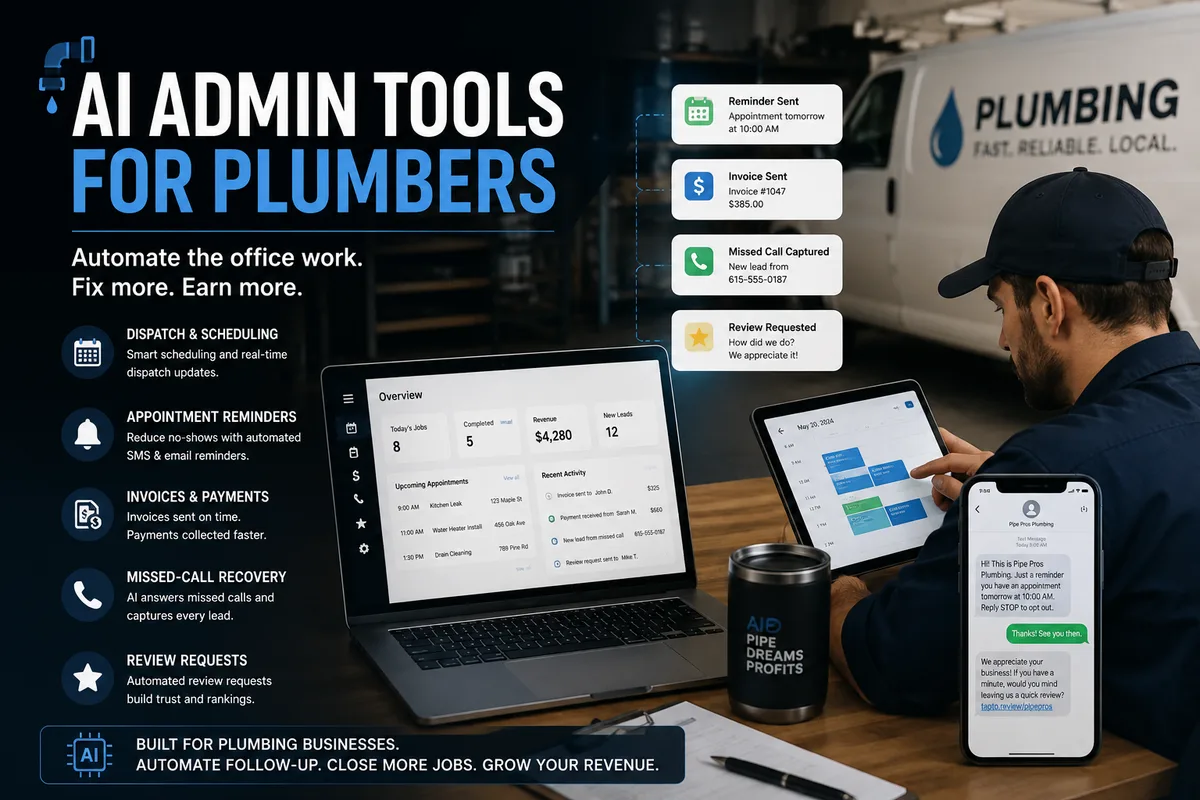
AI Admin Tools for Plumbers: What They Are and How to Choose
AI admin tools automate dispatch, reminders, invoicing follow-up, missed calls, and review requests for plumbers. What they do and how to choose.
Insurance Eligibility Automation for Physical Therapy Clinics
Eligibility automation for physical therapy clinics verifies benefits before the patient arrives, cuts front desk phone work, and can lower claim denial risk.
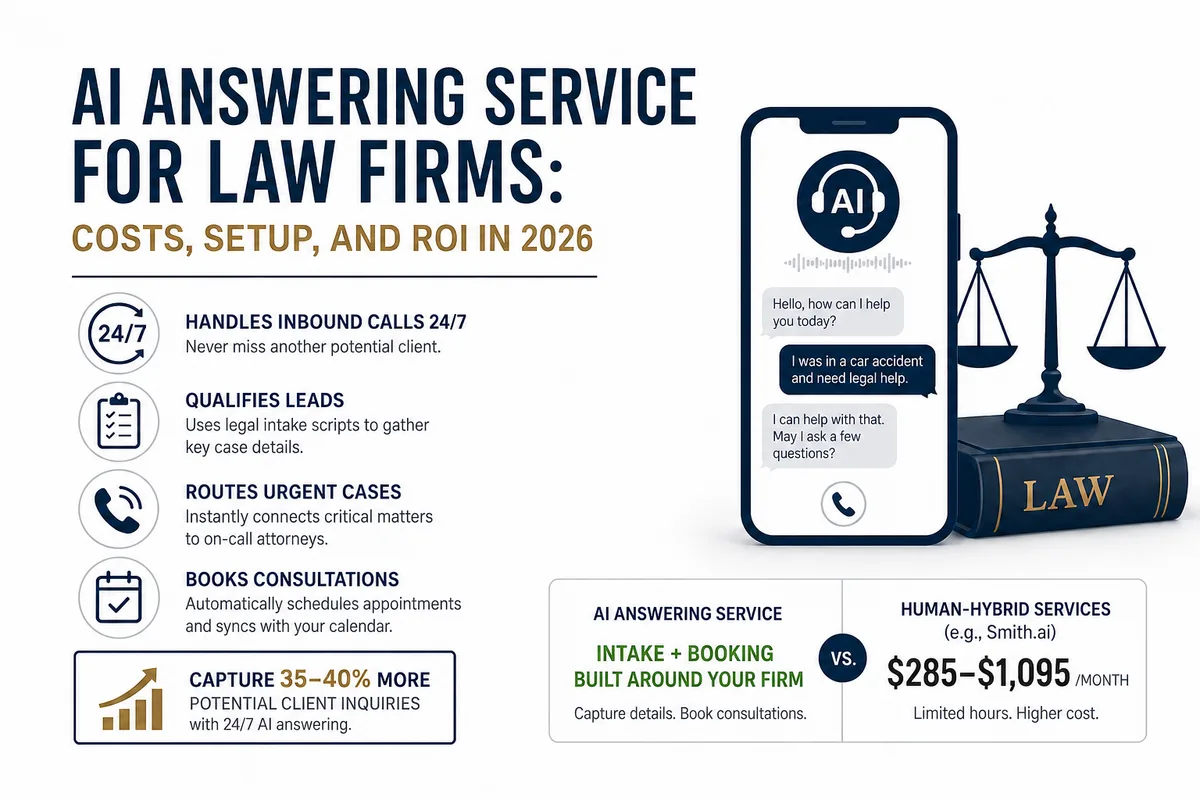
AI Answering Service for Law Firms: Costs, Setup, and ROI in 2026
Law firms miss a large share of inbound calls, most of them after hours. Here's what an AI answering service actually does, what it costs versus human.