
Comparisons & Reviews
AI vs Human Decision Making: What the Data Actually Shows in 2026
Speed and cost favor AI for structured decisions. Human judgment still wins for novel, high-stakes calls. Here's the data-backed breakdown and a practical.
The free 30-minute AI Operations Audit is a conversation about a normal week in your business and where the work piles up. We find the one change that would give you the most time back and send you a plain-English plan for it. No forms and no pitch.
Book a free AI audit
Patrick Gibbs
AI outperforms humans on speed, volume, and consistency for structured, data-rich decisions. Humans outperform AI on novel situations, ethical trade-offs, and anything requiring judgment outside the training data. For most businesses, the best outcomes come from hybrid systems: AI processes the data, humans own the high-stakes calls. Neither replaces the other cleanly.
Speed and Volume: The Gap Is Larger Than Most Expect
AI can process structured inputs quickly, but speed and accuracy depend on the task, model, data and review requirements. A credit decision is not comparable to answering a routine business call. Measure performance on representative cases and keep consequential decisions under the responsible professional’s review. Our AI vs. human receptionist ROI breakdown considers a narrower call-handling workflow.
The numbers get concrete fast. Major banks have used AI contract-analysis systems to cut commercial loan agreement review from an enormous annual hour count to near-instant turnaround, while catching errors that human reviewers routinely missed. That isn't a marginal efficiency gain. It's a categorical change in what a legal review team can accomplish with the same headcount.
The figures below are illustrative operating-cost assumptions. Replace them with your own labor data and provider quotes. Speed also collapses cost per decision. If a human decision costs $12-18 in labor and overhead, and an AI decision costs $0.003-0.01, then scaling from 10,000 to 500,000 decisions per month stops being a staffing problem and becomes a compute cost. For businesses handling high volumes in categories like lead qualification, insurance quotes, fraud flags, or content moderation, this math compounds into a meaningful structural advantage over competitors still running manual processes.
Accuracy: It Depends Entirely on the Decision Type
AI accuracy is narrow and domain-specific. For well-defined, data-rich, stable tasks (radiology screening, fraud detection, credit scoring), strong models can match or exceed specialist human performance. For ambiguous, novel, or ethically complex decisions, that accuracy degrades sharply, and human judgment reliably outperforms any model currently deployed at scale.
AI mammography screening systems have reduced false negatives compared to radiologist panels while simultaneously cutting false positives. In diabetic retinopathy screening, leading models report sensitivity comparable to specialist performance. These results come from narrow, well-scoped domains with decades of labeled training data. The accuracy advantage is real. But it doesn't transfer automatically to a new domain without equivalent data depth: applying AI to an under-labeled decision category typically produces accuracy well below the human baseline it's meant to replace.
The failure mode worth tracking is distribution shift: what happens when real-world conditions change and the model doesn't. Models trained on pre-2020 consumer behavior were largely useless through 2020-2021. Fraud detection systems trained during stable economic periods misfire during economic shocks. One major tech company famously scrapped an AI hiring tool after discovering it had learned to penalize resumes associated with women, because it trained on years of historical hiring data that encoded existing biases. Better training data reduces this risk but doesn't eliminate it. Any model trained on historical data carries this vulnerability when the operating environment shifts significantly.
The Decision Fatigue Problem
Human decision quality degrades measurably throughout the day, regardless of experience or expertise. Judges reviewing parole cases have been observed approving markedly fewer applications in late-afternoon sessions than in morning sessions, with no corresponding change in case merits. The same degradation appears in clinical, financial, and operational decisions. AI doesn't get tired, hungry, or depleted.
The research is consistent across domains: physicians order more unnecessary tests late in clinical shifts, managers approve more budget requests before noon, sales reps make less aggressive follow-up calls in the final hours of their shift. The cognitive depletion is predictable and nobody at your organization is recording it. Nobody logs "this vendor contract got approved at 4:45 PM after the reviewer had already processed 70 documents that day." But the quality difference is real, and it accumulates at scale.
AI models have their own consistency problems, especially around edge cases and distribution shift. But they don't degrade based on time of day, number of prior decisions, or external stress. For any process where your team makes the same category of decision repeatedly, like the ones covered in our guide on automating repetitive tasks in small businesses, that mechanical consistency is itself an argument for AI handling the routine load, even if human accuracy would be higher on any single isolated decision made at peak cognitive performance.
A Practical Hybrid Decision Framework
Effective hybrid systems map decisions along two axes: frequency and consequence severity. High-frequency, low-consequence decisions belong in AI with minimal oversight. Low-frequency, high-consequence decisions require human judgment, with AI providing analysis support rather than recommendations. The middle ground demands honest calibration based on actual data quality and real error costs, not vendor benchmarks.
| Decision Type | Frequency | Consequence | Recommended Approach |
|---|---|---|---|
| Lead scoring / qualification | High | Low | Full AI automation |
| Inventory reorder points | High | Low-Medium | AI with exception alerts |
| Customer escalation triage | Medium | Medium | AI triage, human resolution |
| Vendor contract review | Low | High | AI analysis, human decision |
| Executive hiring | Very Low | Very High | Human primary, AI as reference |
| Crisis or PR response | Rare | Extreme | Human only |
The middle rows in that table are where most organizations make implementation mistakes. They either automate too aggressively, removing human judgment from decisions that genuinely need it, or they apply too much human oversight to decisions that don't warrant it, wiping out the efficiency gains. One practical diagnostic before building anything: audit your last 100 decisions in a given category. How often did the decision require information that doesn't exist in your data systems? How often did the outcome depend on context a model wouldn't have? That ratio is a better guide than any vendor Implementation Example.
ROI Reality Check: What Organizations Actually See
Organizations implementing AI decision tools in well-defined domains report meaningful cost reductions and accuracy improvements over human-only baselines. But only a minority of companies have scaled AI use cases beyond pilot stage, and pilot results degrade substantially in production, meaning results that look strong in a controlled test often fall significantly short in live deployment.
The gap comes from conditions that are artificially good in a pilot: clean data, motivated users, close monitoring, a single clear success metric. Production environments have none of those reliably. Data quality degrades. Users route around the system when it conflicts with their instincts. Monitoring becomes quarterly instead of continuous. Organizations that successfully scale AI decision tools invest heavily in three things: specific training around when to override the model and when to trust it, data pipeline reliability, and ongoing performance monitoring against real-world outcomes rather than pilot benchmarks.
A rough cost-benefit framework: calculate current cost per decision (labor plus overhead plus average error cost), multiply by annual volume, then model a modest accuracy improvement with a large reduction in cost per decision. Those are conservative assumptions for a well-scoped implementation in a structured domain. If the economics work at that level, a pilot is worth running. Our complete AI automation guide for small businesses covers the practical implementation path from pilot to production. If you need to hit vendor headline claims to justify the investment, the risk profile is too high. Most organizations that get burned by AI implementations chased the top-line number instead of stress-testing the conservative case.
"AI vs human" is ultimately the wrong frame for most business decisions. The right question is which combination of tools and judgment, applied to which category of decisions, produces the best outcome given your actual data quality and error costs. That's an operational question with a specific answer, and it's different for every organization. Firms like Epiphany Dynamics help businesses run exactly this kind of decision audit before committing to any build.
See our AI workflow automation guide for small business for a practical implementation roadmap. For platform selection, check the best AI tools for service companies. Learn how to test AI automation before scaling to validate any deployment.Frequently Asked Questions
Q: How much faster can AI make decisions than humans?
For structured decisions like loan underwriting, AI can evaluate hundreds of data points and return a decision quickly, while a loan officer manually reviewing the same application has to work through the file step by step. Major banks have cut commercial loan agreement review from an enormous annual hour count to near-instant turnaround, fundamentally changing what teams can accomplish with identical headcount.
Q: What's the cost difference between AI and human decision-making at scale?
Human decisions in high-volume categories carry labor and overhead costs, while AI decisions shift much of that burden into compute and monitoring costs. Scaling from 10,000 to 500,000 decisions monthly shifts staffing constraints into compute costs, creating structural competitive advantages for businesses automating high-volume decisions.
Q: What types of decisions should AI handle instead of humans?
AI excels at high-volume, structured, data-rich decisions with stable patterns: credit scoring, fraud detection, lead qualification, insurance quotes, and content moderation. Humans retain ownership of decisions requiring ethical judgment, contextual reasoning, or novel situations outside the AI's training data.
Q: Why is hybrid decision-making better than pure AI or pure human systems?
Hybrid systems preserve cost efficiency (AI processes volume at millisecond speed) while protecting against AI's blind spots: novel situations, ethical trade-offs, and judgment calls that require human reasoning. This division of labor gives organizations both speed and the judgment needed for high-stakes decisions.
Patrick Gibbs
AI Automation Expert
Patrick Gibbs helps professional practices implement AI automation that captures more leads, books more appointments, and scales without adding overhead. He's the founder of Epiphany Dynamics and creator of the AI Front Desk system.
Related Solutions
Build this into a real workflow
Related Posts
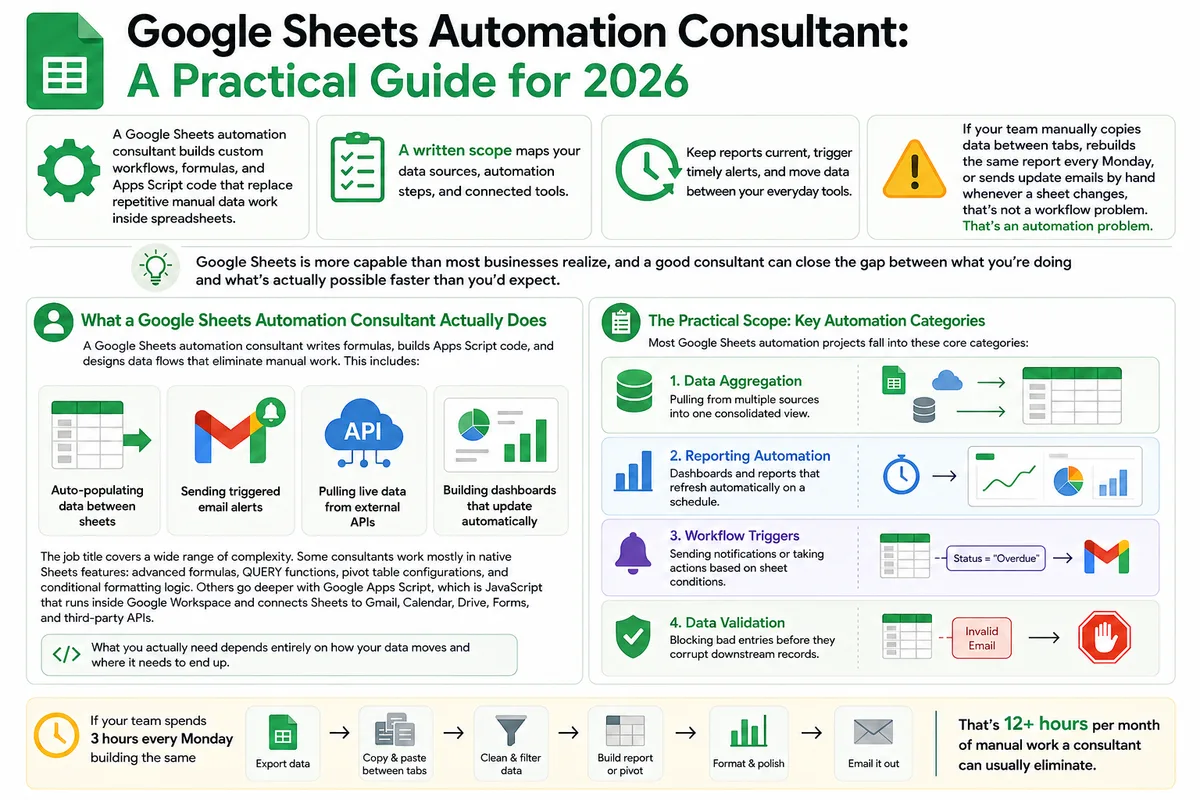
Google Sheets Automation Consultant: A Practical Guide for 2026
Most businesses don't track what spreadsheet work actually costs them. Here's what a Google Sheets automation consultant does in 2026, how to judge the value.
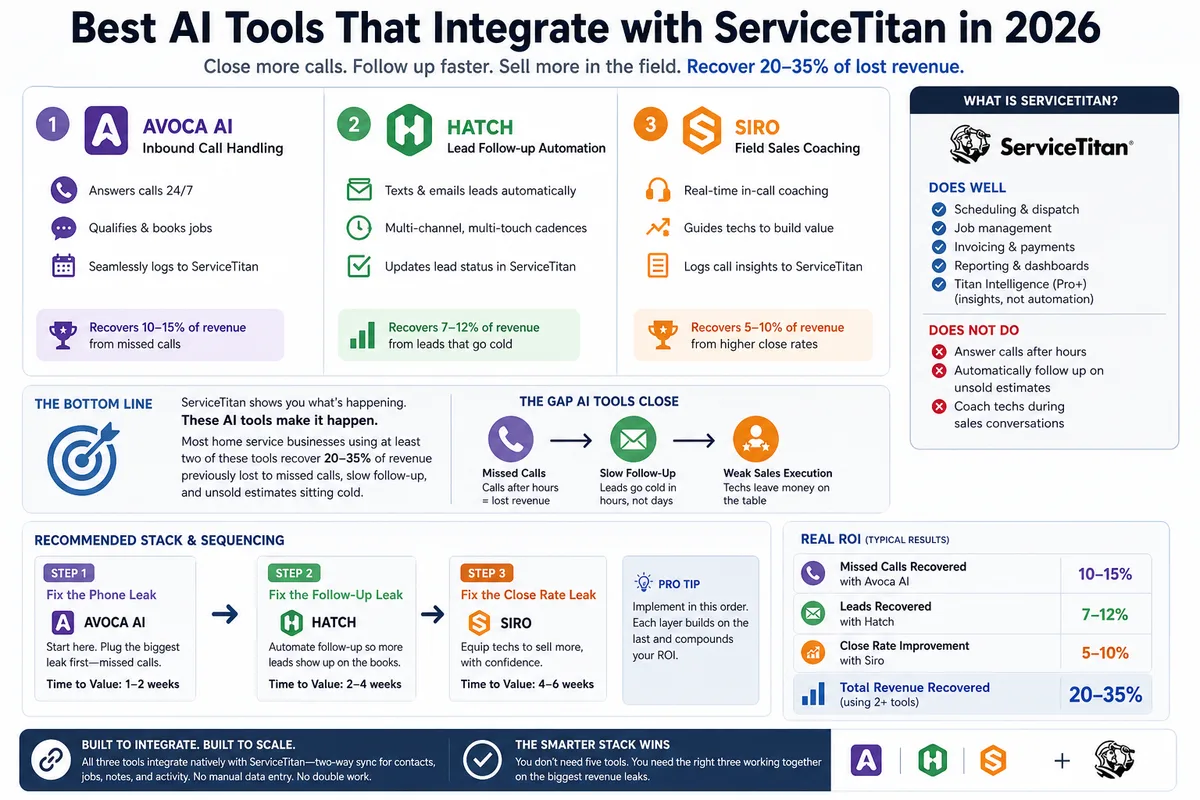
Best AI Tools That Integrate with ServiceTitan in 2026
Most ServiceTitan shops miss a meaningful share of inbound calls and leave most estimates unsold. These AI tools close those gaps inside ServiceTitan.
n8n Workflow Automation Agency: What They Build, What It Costs (2026)
Zapier pricing drove you to n8n. Now you're wondering if hiring an agency to build it makes sense. Here's what they build, what projects cost, and how to.