
AI Voice Technology
How to Reduce Phone Staff Costs with AI: Cost Drivers and Rollout
AI voice agents can reduce the amount of routine call work assigned to human staff. Here is how to compare labor cost, coverage gaps, call types, and rollout.
The free 30-minute AI Operations Audit is a conversation about a normal week in your business and where the work piles up. We find the one change that would give you the most time back and send you a plain-English plan for it. No forms and no pitch.
Book a free AI audit
Patrick Gibbs
AI voice agents can absorb a large share of structured inbound call volume, which changes how many human hours you need at the front desk. The right business case compares fully loaded labor cost, coverage gaps, missed-call value, subscription cost, setup effort, and escalation quality. This post shows how to build that comparison for your own operation.
Most business owners treat their front desk phone staff as a fixed cost of doing business, a necessary overhead line that doesn’t get scrutinized the way marketing spend or inventory does. That’s a math error. A base wage looks manageable on a budget sheet until you stack in payroll taxes, health insurance contributions, PTO, training, and the recurring cost of turnover. The real number is always higher than the wage line, and that’s before accounting for the calls that still don’t get answered after hours.
AI voice technology has come a long way from the early days of “press one for billing.” Modern AI voice agents, built on large language models with real-time speech synthesis, can hold natural conversations, schedule appointments, collect intake information, answer complex FAQs, and escalate to a human when a situation genuinely requires one. For businesses with meaningful inbound call volume, the cost differential between AI and human phone staff is large enough to change how you budget for the front desk.
The True, Fully-Loaded Cost of Phone Staff
The headline salary number is almost always deceptive. The total employer cost looks substantially different when you account for every real line item:
- Payroll taxes: employer-side taxes above base wages.
- Benefits: health insurance contributions and any retirement or stipend programs.
- PTO and sick leave: paid time that still requires coverage.
- Workers’ compensation insurance: a small line item that still belongs in the full cost.
- Onboarding and training: ramp time, supervision, and process documentation.
- Turnover replacement cost: recruiting, temporary coverage, lost continuity, and the new hire ramp.
The result: the fully loaded cost of human phone coverage is materially higher than the visible wage line. For businesses running multiple phone staff members, that compounds quickly. And despite that investment, after-hours calls, peak-hour overflow, and weekend inquiries still often reach voicemail. Every unanswered call is a prospect dialing your competitor instead. The true cost of those missed calls includes wasted marketing spend and lost lifetime customer value.
What AI Voice Agents Actually Handle
The most persistent misconception about AI voice is binary thinking: either it handles everything flawlessly, or it’s barely better than a phone tree. The practical reality is more useful than either extreme. Modern AI voice agents are specifically strong at the high-volume, predictable call types that make up a large share of inbound traffic at most service businesses.
Where AI voice performs reliably: appointment scheduling, rescheduling, and confirmations; business hours, directions, and FAQ responses; new customer intake (name, reason for inquiry, insurance type, contact details); pricing and service inquiries; quote requests and callback scheduling; payment status and billing FAQs; after-hours lead capture and triage.
Where human agents still add clear value: complex complaints requiring empathy and relationship repair; high-value consultative sales conversations; situations requiring cross-system judgment AI hasn’t been configured for; genuinely novel scenarios outside trained parameters.
The operational model that works: AI handles the volume, humans handle the exceptions. Conversational AI is widely expected to absorb a growing share of contact center volume in the coming years, and in SMB contexts with narrow, well-defined use cases, operators already running these systems often report meaningful deflection of routine calls.
The Math: Side-by-Side Cost Comparison
The financial case depends on your own baseline. The table below compares the cost drivers of a human phone agent against a typical AI voice deployment:
| Cost Category | Human Phone Agent | AI Voice Agent |
|---|---|---|
| Base annual cost | Wages or salary | Recurring subscription and usage |
| Benefits + payroll taxes | Required employer expense | Not a labor burden |
| Turnover/replacement (amortized) | Recruiting, coverage, and ramp cost | Vendor-switching or retuning cost |
| Training (initial + ongoing) | Staff ramp and ongoing coaching | Script, knowledge base, and escalation tuning |
| After-hours availability | Not available | Available when configured |
| Simultaneous call capacity | One call per agent | Unlimited concurrent |
| Total estimated annual cost | Fully loaded labor baseline | Software, usage, setup, and monitoring cost |
The cost-per-call differential reinforces the picture. Human call cost rises with wages, call length, staffing coverage, and idle time. AI call cost rises with subscription tier, usage, voice quality, and integration depth. AI cost structures usually scale differently than human coverage, which is why the business case gets stronger when the call mix is routine and volume is steady.
There’s also a revenue dimension the table doesn’t capture. Businesses deploying AI voice often capture after-hours leads they were previously losing entirely. For a home services company handling emergency calls, the value of one recovered job can be enough to justify careful after-hours coverage. Use your own average ticket, booking rate, and missed-call data rather than relying on generic benchmarks.
Where AI Voice Delivers the Fastest ROI
Certain business types tend to see the fastest payback. The pattern is consistent: high inbound call volume, predictable call types, and meaningful after-hours demand. Three industries produce the clearest wins:
Medical and Dental Practices
A multi-provider practice often has appointment scheduling, confirmations, insurance questions, and basic FAQs making up much of the phone volume: precisely the call types AI handles well. Beyond cost savings, practices report meaningful operational improvement: clinical support staff pulled onto phone duty during procedures is a patient safety issue, not just an efficiency one. An AI system that handles the appointment queue frees clinical staff to stay focused on the patient in the chair.
Home Services (HVAC, Plumbing, Electrical)
Call spikes in home services happen exactly when human staff are least available: holiday weekends, evenings during heat waves, and overnight emergencies. AI voice handles triage, collects job details, and dispatches notifications without requiring continuous dispatcher coverage. For a company where emergency calls carry high job value, missed-call loss is recurring and real. AI eliminates it structurally, not by working harder. See how Dallas contractors eliminate voicemail forever and recover significant annual revenue.
Med Spas and Aesthetic Clinics
Consultation requests, treatment FAQs, pricing inquiries, appointment bookings, pre-appointment instructions, and no-show follow-ups are all highly standardizable for these businesses. They also tend to have high-ticket services and a client base that expects fast, responsive communication. AI voice absorbs the intake and scheduling load; front desk staff focus on the client experience inside the building.
How to Phase In AI Without Disrupting Operations
The businesses that fail with AI voice usually try to automate everything simultaneously. Those that succeed treat deployment as a phased staffing decision: controlled, measurable, and reversible at each stage.
Phase One: After-Hours Only
Deploy AI voice exclusively for calls outside business hours. This creates minimal disruption to current staff or workflows. It captures missed calls after closing and on weekends while building real data on after-hours call volume and intent before touching daytime operations. Many businesses discover that after-hours demand is larger than they assumed, which strengthens the case for expanding the deployment.
Phase Two: Overflow Routing
Route calls to AI when all human agents are occupied. This reduces hold times, captures overflow volume, and generates direct performance comparisons between AI and human handling on identical call types. It’s also the natural point to review call recordings, identify gaps in AI responses, and refine the system’s knowledge base before a broader rollout. Build review time into the phase; the ROI on that tuning work is high.
Phase Three: Primary Handler with Escalation
After validating performance across a real call sample, flip AI to first-contact for defined call categories such as scheduling, FAQs, and intake, with tested escalation paths to human staff for exceptions. Staff roles shift from answering phones all day to handling escalations and complex calls. Businesses running this model should calculate breakeven from their own staffing baseline, call volume, and how much human phone coverage has been reduced or redirected.
Technical requirements before any deployment:
- Calendar/CRM integration: An AI that can’t access your scheduling system can’t book appointments. Verify integration capability before selecting a vendor; this is non-negotiable for service businesses.
- Escalation logic: Define exactly which call types or trigger phrases route to a human (complaint escalations, billing disputes, distressed callers) and test those paths rigorously before go-live.
- Call review cadence: Budget recurring time during rollout to listen to AI-handled calls and refine response logic. This is where most of the system’s performance improvement happens.
- Compliance: Healthcare businesses must confirm the AI vendor provides a HIPAA Business Associate Agreement (BAA). This is a legal requirement, not optional.
The Bottom Line
AI voice technology is not a future capability: it’s a cost lever available now for businesses with meaningful phone staffing expense. A well-deployed AI voice system can cost far less than equivalent human phone capacity, handle much of the routine call volume, and operate continuously with no sick days, no turnover, and no holiday coverage gap.
The businesses succeeding with this technology aren’t cutting corners on customer experience. They’re recognizing that most inbound calls don’t require a human: they require a fast, accurate, and available response. AI delivers that at scale. Human staff then focus on the calls that genuinely benefit from human judgment: service recovery, complex consultations, and high-stakes relationships where a person on the phone actually moves the needle.
If you’re evaluating AI voice for your business, the core question is how the math works in your operation. The real questions are which vendor’s integration capabilities match your existing systems, and which rollout timeline fits your operational complexity. Our AI front desk cost guide walks through pricing tiers and what to expect during rollout. Firms like Epiphany Dynamics have built their practice specifically around helping service businesses navigate this transition from first audit through full production deployment.
Frequently Asked Questions
Q: What is the actual fully loaded annual cost of a phone receptionist at a small service business?
A receptionist costs more than the visible wage line once you stack in payroll taxes, health insurance contributions, PTO, workers’ compensation, onboarding, and turnover. For businesses running multiple phone staff, that compounds quickly before accounting for the calls that still go unanswered after hours.
Q: What call types does AI voice handle reliably versus where it falls short?
AI voice performs reliably on appointment scheduling, rescheduling, confirmations, business hours and directions, FAQ responses, pricing inquiries, new customer intake, and after-hours lead capture, which often make up much of total inbound volume. It falls short on high-emotion complaints requiring empathy and relationship repair, complex multi-system judgment calls, and callers who disengage when they detect automation. The winning model is AI for volume, humans for exceptions.
Q: What is the cost-per-call comparison between human phone staff and AI voice in production?
Human call cost depends on wages, call length, staffing coverage, benefits, idle time, and turnover. AI call cost depends on subscription tier, usage, voice quality, integrations, and monitoring. Compare both on a cost-per-resolved-call basis rather than a raw subscription-versus-salary comparison.
Q: How should a business phase in AI voice coverage to avoid disrupting operations?
Deploy after-hours only first with minimal disruption to existing staff. Then add overflow routing when all human agents are occupied. After you have real performance data, move AI to first-contact for defined call categories with clean escalation paths for exceptions. Use your own call volume, staffing cost, and coverage changes to calculate breakeven and net savings from the phased approach.
Q: What compliance requirement applies specifically to healthcare businesses deploying AI voice?
Healthcare businesses must obtain a signed Business Associate Agreement (BAA) from any AI voice vendor whose system handles, stores, or transmits protected health information. This is a legal HIPAA requirement, not a vendor option or marketing checkbox. BAA availability should be a hard gate in vendor evaluation: no BAA means no deployment in any healthcare-adjacent context, regardless of how impressive the demo is.
Patrick Gibbs
AI Automation Expert
Patrick Gibbs helps professional practices implement AI automation that captures more leads, books more appointments, and scales without adding overhead. He's the founder of Epiphany Dynamics and creator of the AI Front Desk system.
Related Solutions
Build this into a real workflow
Related Posts
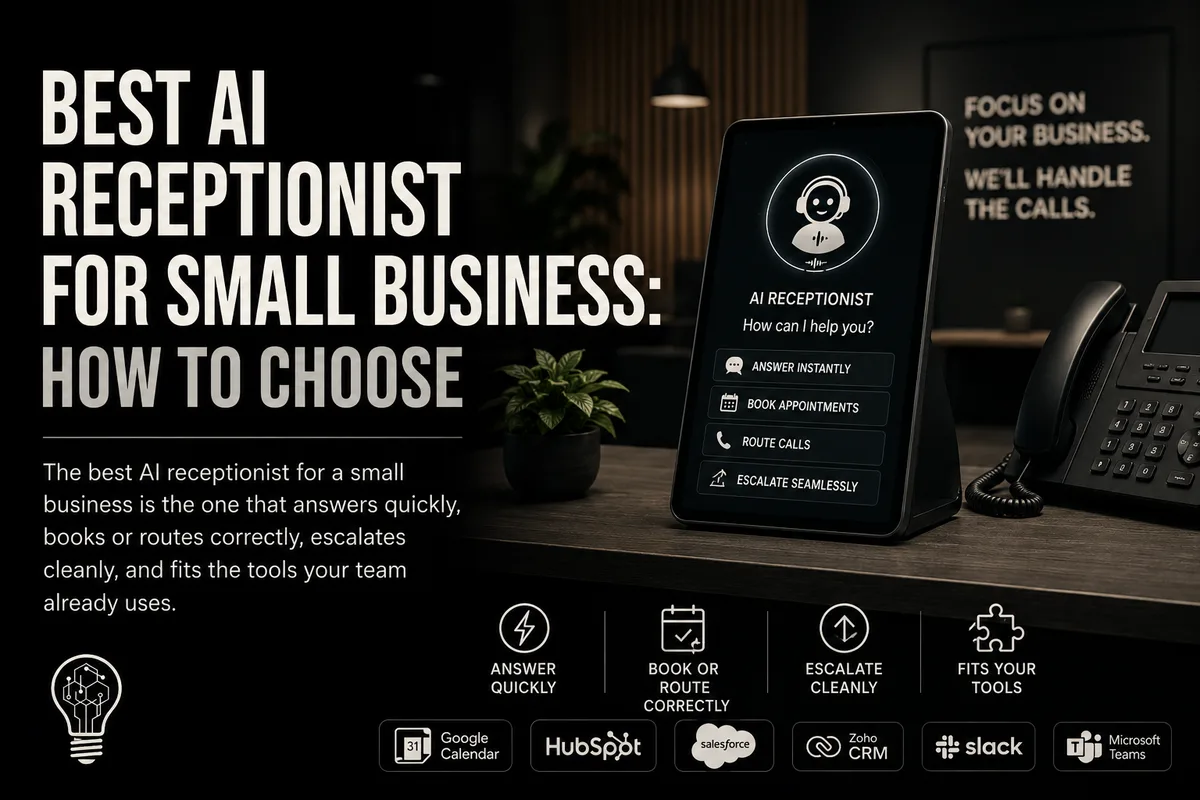
Best AI Receptionist for Small Business: How to Choose
The best AI receptionist for a small business is the one that answers quickly, books or routes correctly, escalates cleanly, and fits the tools your team.
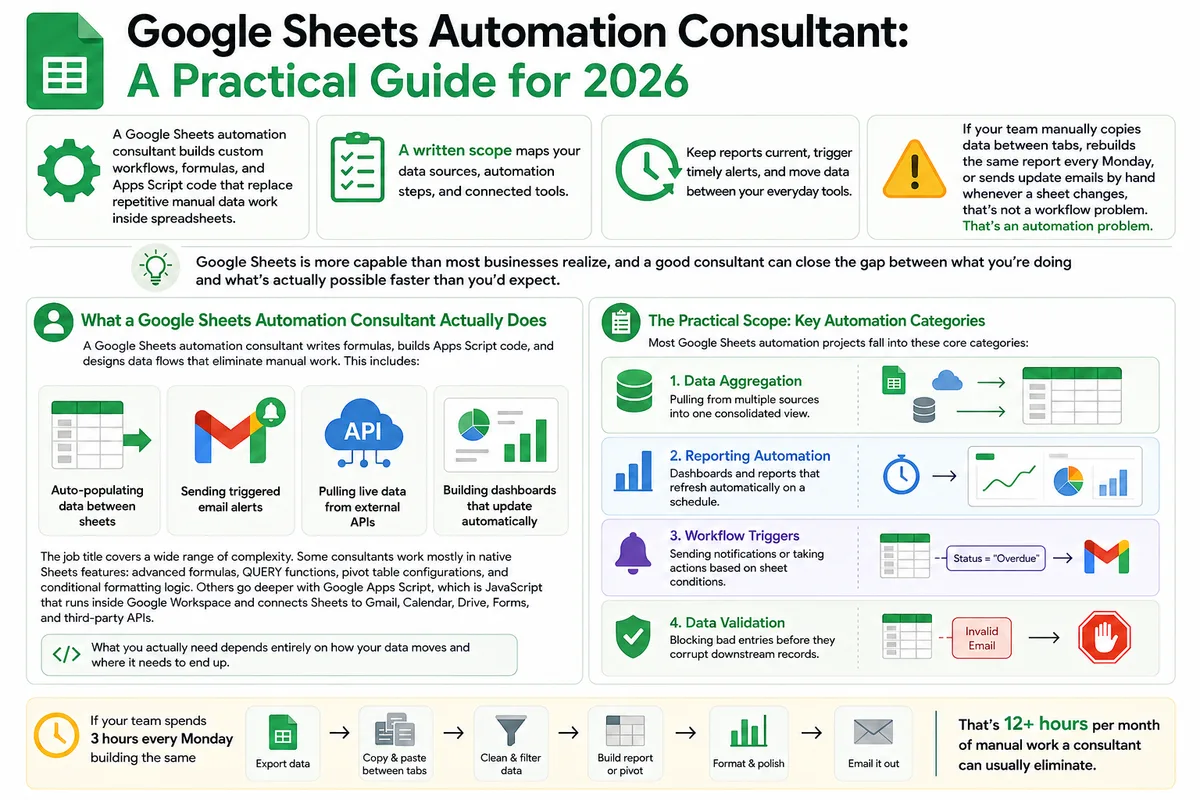
Google Sheets Automation Consultant: A Practical Guide for 2026
Most businesses don't track what spreadsheet work actually costs them. Here's what a Google Sheets automation consultant does in 2026, how to judge the value.
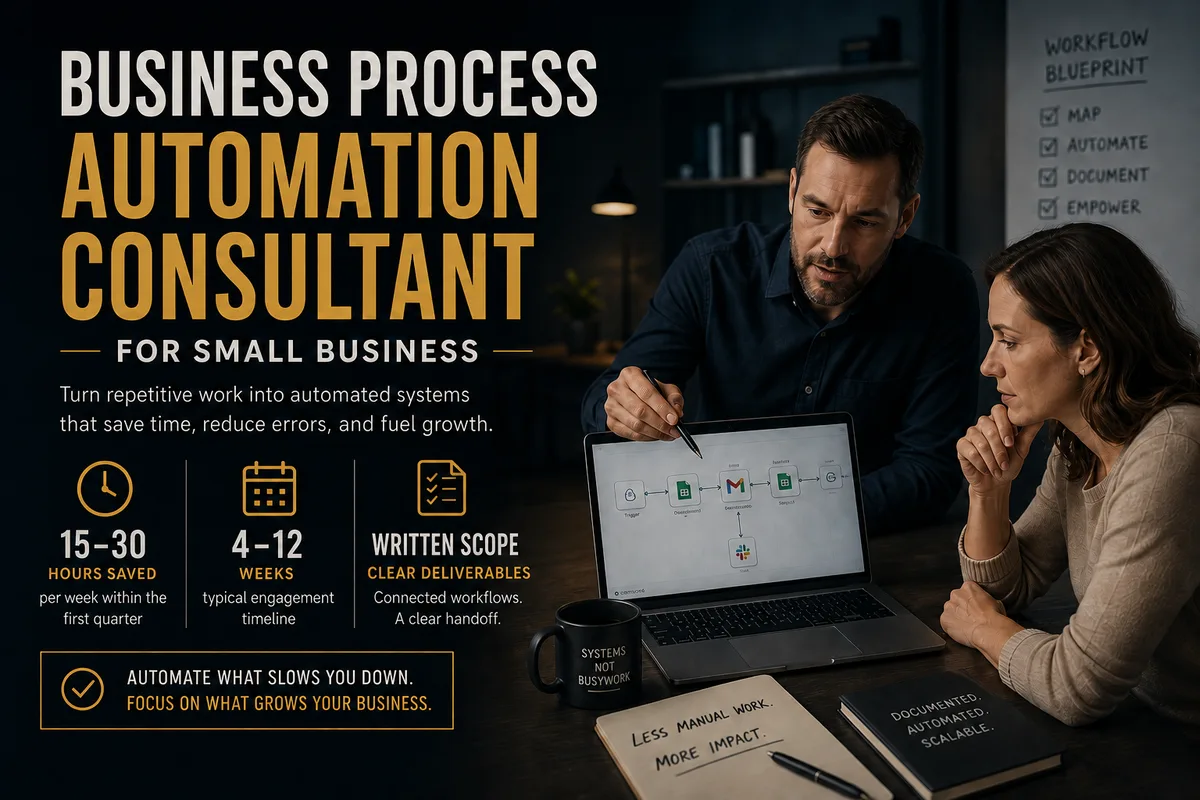
Business Process Automation Consultant for Small Business
Hiring the wrong automation consultant wastes thousands. Here's what small business owners need to know about process, cost, ROI, and how to vet the right one.