
Solutions & Services
How Much Does AI Integration Cost? Connecting AI to Your Existing Systems
Compare hypothetical AI integration budgets by system count, API complexity and custom logic, then obtain a written quote for your actual workflow.
The free 30-minute AI Operations Audit is a conversation about a normal week in your business and where the work piles up. We find the one change that would give you the most time back and send you a plain-English plan for it. No forms and no pitch.
Book a free AI audit
Patrick Gibbs
The following figures are hypothetical outside-provider budget scenarios, not verified market rates or Epiphany Dynamics prices. Replace them with current written quotes for the same scope. An example custom integration budget ranges from $500 to $15,000+ for custom work, depending on the number of systems, API availability, and complexity of the logic. Example worksheet allowances are $500-$2,000 for a simple two-system connection, $2,000-$6,000 for several connected systems, and $6,000-$15,000+ for a more involved workflow. A $200-$1,000/month maintenance allowance is another sample input. None of these amounts establishes the cost of your project.
These hypothetical allowances help structure a quote request. Your actual build depends on systems, volume, workflow complexity and the business case mapped during the free audit.
What AI Integration Actually Means
AI integration is the work of connecting an AI system — a chatbot, voice agent, or automation workflow — to the software your business already uses. Without integration, your AI operates in a silo: it can answer questions but cannot book appointments, update records, or trigger follow-ups.
The cost of integration depends primarily on three factors:
- API availability — Does your CRM, calendar, or phone system have a well-documented API? Modern platforms like HubSpot, Calendly, and Twilio make integration cheap. Older or closed systems are much more expensive to connect.
- Data complexity — Does the integration need to read data, write data, or both? Is there conditional logic (if X happens, then do Y in system Z)? More logic equals more build time.
- Number of systems — Each additional system adds complexity, testing, and failure points.
Integration Cost by Scope
| Integration Scope | Typical Cost | Timeline | Example |
|---|---|---|---|
| Single connection (AI to 1 system) | $500 - $2,000 | 3 - 7 days | AI chatbot writes leads to HubSpot CRM |
| Mid-scope (AI to 2-3 systems) | $2,000 - $6,000 | 1 - 3 weeks | AI voice agent books appointments in Calendly, sends SMS via Twilio, logs calls in CRM |
| Complex workflow (4+ systems, custom logic) | $6,000 - $15,000+ | 3 - 6 weeks | Full intake automation: AI routes calls based on service type, checks staff availability, books into multiple calendars, sends intake forms, updates billing system |
These figures assume your systems have standard APIs (REST, GraphQL, or webhook support). If your business relies on legacy software without modern API access, integration costs can double or triple because the agency needs to build custom middleware or use screen-scraping techniques.
Also on the blog: How Much Does an AI Chatbot Cost? Pricing Breakdown for Small Business Owners.
Integration Platforms vs. Custom Development
There are two approaches to AI integration, and they have very different cost profiles.
No-Code Integration Platforms
Tools like Make.com (formerly Integromat), n8n, and Zapier act as bridges between AI systems and your existing software. They offer pre-built connectors for most popular business tools.
Pros: Lower cost, faster setup, visual interface that non-technical staff can modify. Cons: Limited to supported connectors, monthly action caps on most plans, less flexibility for complex conditional logic.
Illustrative budget input: $20-$200/month for the platform subscription, plus agency setup time of $500-$2,000.
Custom API Development
When your system has no pre-built connector, or when you need complex logic that no-code platforms cannot handle, a developer writes custom code using the system’s API documentation.
Pros: Unlimited flexibility, no platform dependency, can handle any business logic. Cons: More expensive, takes longer, requires ongoing maintenance as APIs change.
Illustrative budget input: $2,000-$10,000+ for development, $200-$500/month for maintenance.
Hidden Integration Costs
Webhook and middleware hosting. If your integration uses custom middleware (a small server that processes data between systems), a worksheet might allow $10-$50/month for hosting, subject to a current quote and measured usage.
API rate limits. Some systems limit how many API calls you can make per minute or per day. If your AI handles high volume, you may need to upgrade your plan on the connected systems.
Authentication maintenance. APIs change their authentication methods periodically. When they do, your integration needs updating. This is typically covered by the monthly maintenance fee.
Testing and edge cases. The first integration build always uncovers edge cases that were not anticipated. Budget a large share of above the quoted price for the first go-live.
DIY Integration Costs
If you have technical skills or a developer on staff, you can handle integration yourself. Use an explicit worksheet; the amounts and hours below are hypothetical inputs, not current plan prices or delivery estimates:
- Illustrative platform allowance: $20-$50/month; replace with the current plan quote
- API documentation: Free
- Illustrative developer-time allowance: 10-40 hours; estimate against the actual scope
The trade-off is that the person doing the build also handles ongoing maintenance, troubleshooting, and updates. For businesses without dedicated technical staff, an agency is usually more cost-effective in the long run.
FAQ
What is the cheapest way to integrate AI with my CRM? Use no-code platforms like Make.com or Zapier to connect your AI tool to your CRM. If you handle the setup yourself, use the current platform quote; $20-$50/month is only a sample worksheet allowance.
How much does it cost to integrate AI with a custom or legacy system? For a custom system without a suitable API, $5,000-$15,000+ is only an illustrative budget scenario. Establish supported access, maintenance responsibility and failure recovery before accepting a quote; screen scraping is not automatically an appropriate integration method.
Do AI agencies include integration in their pricing? Most agencies include basic integration in their setup fee. Complex multi-system integrations are usually quoted separately. Always ask what is included before signing.
Can integration be done without APIs? Some automation platforms offer web scraping or email-based triggers for systems without APIs. These are less reliable and should be considered temporary solutions.
How often do integrations break? Integrations break when a connected system updates its API. Changes do not follow one universal schedule. Assign an owner to monitor provider notices, test integrations and maintain a working fallback.
Getting Started
Start by listing the systems you want your AI to connect with. Check if each one offers API access or a supported connector in Make.com or n8n. Share this list with any agency you talk to — it is the single biggest factor in pricing. Our AI automation pricing overview provides additional context on how integration costs fit into larger automation budgets.
Patrick Gibbs
AI Automation Expert
Patrick Gibbs helps professional practices implement AI automation that captures more leads, books more appointments, and scales without adding overhead. He's the founder of Epiphany Dynamics and creator of the AI Front Desk system.
Related Solutions
Build this into a real workflow
Related Posts
AI Automation Agency for SMBs: What to Look For
A practical guide to choosing an AI automation agency for SMB workflows, from call intake and scheduling to CRM updates, follow-up, and maintenance.
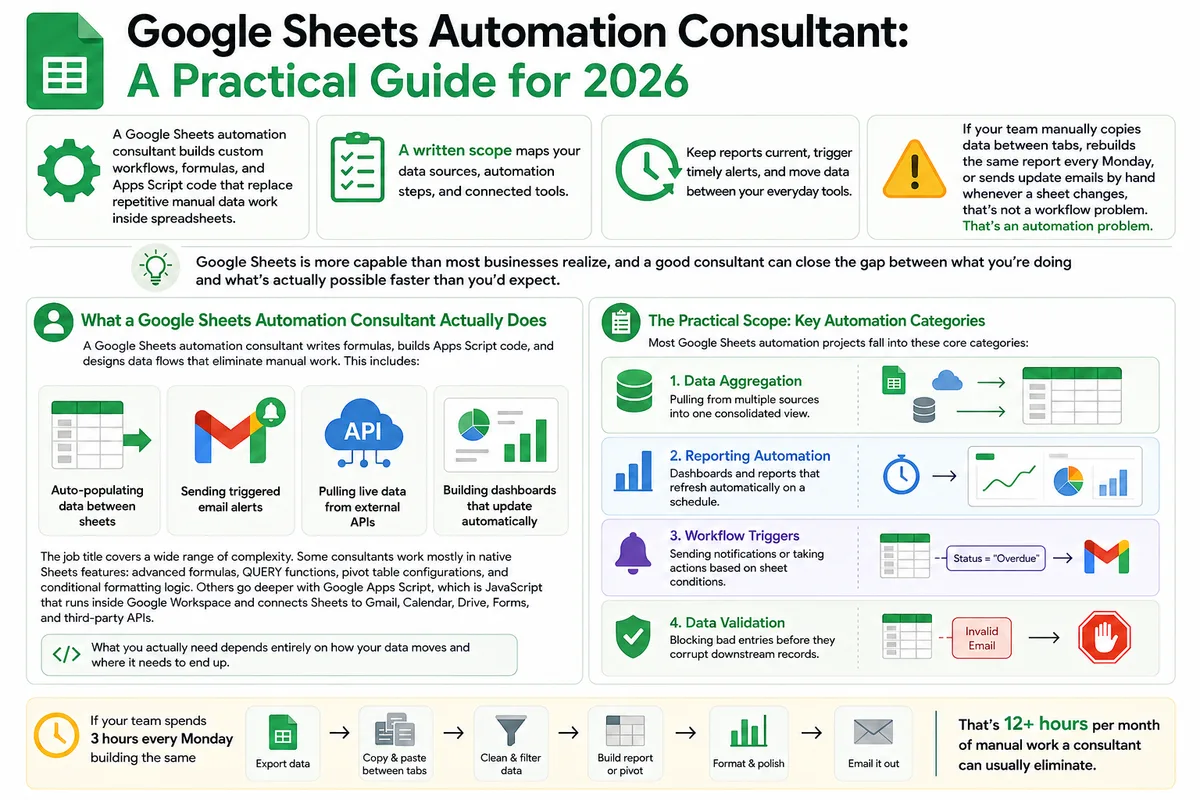
Google Sheets Automation Consultant: A Practical Guide for 2026
Most businesses don't track what spreadsheet work actually costs them. Here's what a Google Sheets automation consultant does in 2026, how to judge the value.

Business Process Automation Consultant for Small Business
Hiring the wrong automation consultant wastes thousands. Here's what small business owners need to know about process, cost, ROI, and how to vet the right one.