
AI Strategy
Small Business AI Adoption Statistics 2026: U.S. Report
See the latest 2026 small business AI adoption statistics from Census, NFIB, U.S. Chamber, JPMorgan, and more, with practical takeaways for SMB operators.
The free 30-minute AI Operations Audit is a conversation about a normal week in your business and where the work piles up. We find the one change that would give you the most time back and send you a plain-English plan for it. No forms and no pitch.
Book a free AI audit
Patrick Gibbs
How many U.S. small businesses use AI? The answer depends on who was surveyed and what counted as use. In 2025, 58% of small businesses in a U.S. Chamber of Commerce survey said they used generative AI. A Federal Reserve analysis found about 18% of U.S. employer firms of all sizes used AI by year-end. Each figure answers a different question.
The tables below distinguish what businesses reported using from the AI services they paid for. The workplace surveys measure what employees experienced. Each section links to the original research so you can choose the figure that fits your question.
Key Statistics at a Glance
Every figure below is sourced in this article and listed in full in the Sources section. Jump to a topic: adoption rates, what SMBs use AI for, ROI, barriers, verticals by industry.
Read the population and measure beside each figure. An employer survey, a survey of business owners, and observed payments to AI providers answer different questions. Company project quotes are separate from these research figures.
| Statistic | Figure | Source |
|---|---|---|
| U.S. firms that had adopted AI by year-end 2025 | about 18% | Federal Reserve / Census BTOS, 2026 |
| Small businesses using generative AI | 58% | U.S. Chamber of Commerce, 2025 |
| Small business owners reporting current AI use | 24% | NFIB, 2025 |
| Small businesses using AI (up from 39% in 2024) | 55% | Thryv, 2025 |
| AI users reporting a positive impact on their business | 93% | Goldman Sachs, 2026 |
| AI users saving $500 to $2,000 per month | 66% | Thryv, 2025 |
| AI users saving more than 20 hours per month | 58% | Thryv, 2025 |
| Median monthly spending among firms making identifiable AI payments (roughly $80 in 2022) | roughly $30 in 2025 | JP Morgan Chase Institute, April 2026 |
| Businesses where AI is fully embedded in core operations | 14% | Goldman Sachs, 2026 |
| Construction firms making identifiable AI-service payments in the Chase sample | 8.9% | JP Morgan Chase Institute, Dec 2025 |
| Information services firms making identifiable AI-service payments in the Chase sample | 39.3% | JP Morgan Chase Institute, Dec 2025 |
Want these numbers turned into action? Join the Epiphany Dynamics newsletter for practical AI automation breakdowns built for service businesses. Join the Epiphany Dynamics newsletter.
What This Means for Service Businesses
The headline numbers are national and cross-industry, but the actionable signal for a service business is narrower. Three things stand out:
- Industry. Identify whether a figure counts firms, workers or payments before comparing two sectors.
- Payback. Record the time a task takes before a pilot and what it costs to operate afterward.
- Customer communication. Count the bookings or replies already handled by staff to decide where a trial has enough volume to measure.
If you want to see what that looks like in a specific vertical, see our work on an AI receptionist for HVAC contractors, an AI receptionist for med spas, and insurance eligibility automation for physical therapy clinics, plus our roundup of the best AI tools for physical therapy. For the bigger question of whether this is worth doing now, see is AI automation in demand, and the overview of what an AI implementation engagement looks like. When you are ready to scope your own highest-value use case, you can book a working session.
How to Cite This Page
Journalists, researchers, and analysts are welcome to cite this roundup. Suggested citation:
Gibbs, Patrick. "The State of AI Adoption in U.S. Small and Mid-Sized Businesses in 2026." Epiphany Dynamics, 2026, https://epiphanydynamics.si/blog/state-of-ai-adoption-us-small-business-2026/.
Every statistic on this page traces back to a primary source in the Sources section. When citing an individual figure, please reference the original source listed there.
How Many SMBs Are Actually Using AI
The short answer is "more than you think, less than the headlines suggest." The longer answer depends on how you define "using AI."
The Federal Reserve estimated that about 18% of U.S. employer firms used AI at year-end 2025. Census changed the question in late 2025 from use in producing goods or services to use in any business function. Before that change, measured use rose 68% in the year ending September 2025. The Census BTOS contacts one cohort about every two weeks.
Under the earlier Census question about using AI to produce goods or services, the SBA Office of Advocacy found 6.3% of firms with fewer than 250 employees used it, compared with 11.1% of firms with 250 or more. Six months later the smaller-firm figure was 8.8%. In a separate banking sample, the JPMorgan Chase Institute found identifiable AI payments in the first month for 1.2% of the 2019 cohort and 6.5% of the 2025 cohort.
Survey data tells a different story from transaction data, primarily because it asks different questions. The U.S. Chamber of Commerce's 2025 Empowering Small Business report found that 58% of small businesses say they use generative AI, up from 40% in 2024 and more than double the 2023 rate. The NFIB's Small Business and Technology Survey (2025) found a more conservative 24% of small employers currently using AI tools like ChatGPT, Grammarly, and Canva. Thryv's 2025 survey of 540 small business decision-makers found 55% using AI, up from 39% in 2024 - a 41% jump year-over-year.
The Census methodology covers employer businesses. The full NFIB survey includes owners with no employees. Thryv surveyed 540 business decision-makers at firms with 1 to 100 employees and revenue of $100,000 to $9.9 million. These samples cannot be combined into a single national adoption rate.
Chart sources: Federal Reserve / Census BTOS, NFIB, Thryv, and U.S. Chamber of Commerce.
In the JPMorgan Chase Institute banking sample, it took the 2025 cohort about six months for 10% to make an identifiable AI payment. The 2019 cohort took 77 months. The shorter interval measures paid adoption in this sample.
What SMBs Are Using AI For
The 2025 NFIB survey asked which activities owners used AI for or planned to use it for. The responses below combine those two groups. Respondents could name more than one activity.
- Communications (email, memos, documents): 29%
- Marketing or advertising: 27%
- Business analysis or predictive analysis: 14%
- Customer service: 9%
- Accounting: 4%
- Process automation: 4%
- Cybersecurity or fraud detection: 4%
Thryv reported that 62% used AI for data analysis, 55% for content generation and 46% for customer engagement tools such as chatbots. The survey included small businesses across sectors. These percentages describe its respondents.
The spread makes sense when you think about where small business owners feel the most immediate pain. Writing is a daily task for almost every owner - proposals, emails, social posts, job listings. That's where AI delivers a near-instant win with zero integration work. Customer service automation requires more setup but has one of the clearer ROI paths: a chatbot or voice agent that handles after-hours inquiries doesn't replace an employee, it covers hours you never staffed to begin with.
Among marketing functions specifically, HubSpot's 2026 State of Marketing report found that the large majority of marketing teams now use AI in at least a few marketing areas, with content creation the most common use case.
Goldman Sachs surveyed 1,256 participants in its 10,000 Small Businesses program between January 27 and February 4, 2026. Of those surveyed, 76% reported using AI and 14% said it was fully embedded in core operations.
What the ROI Signal Actually Shows
The ROI data on small business AI is genuinely strong - with a catch. The catch is that most of the positive numbers come from businesses that went past surface-level tool usage into actual workflow integration.
Among Thryv's 2025 survey respondents who use AI regularly:
- 58% report saving over 20 hours per month
- 66% say AI saves their business between $500 and $2,000 monthly
- 63% use AI daily
Salesforce surveyed 3,350 business leaders worldwide in August and September 2024. Among SMB respondents using AI, 91% said it boosted revenue. Across the sample, 75% were experimenting with or using AI, including 83% of growing businesses. Among growing SMBs, 78% planned to increase AI investment, versus 55% of declining peers. Those answers report leaders’ experiences and plans.
Goldman Sachs's 2026 small business survey found that 93% of small business owners currently using AI say it has had a positive impact on their business, with 84% citing increased efficiency and productivity as the primary benefit.
At the individual task level, the direction is consistent: professionals draft documents meaningfully faster with AI writing assistance, customer service agents handle more inquiries per hour with AI support tools, and deployments that add AI triage cut first response times from hours to minutes.
In the NFIB survey, 30% reported higher productivity and 23% reported improved product or service quality. Another 8% reported lower operating costs and 5% reported higher revenue. Among owners using AI, 98% reported no change in headcount attributable to it.
Chart sources: Goldman Sachs, Salesforce, and Thryv.
In February 2026, Gallup found that 65% of employees in organizations implementing AI said it improved their productivity and efficiency. Workers at AI-adopting organizations more often reported that their employer was expanding headcount, 34% versus 28% elsewhere. Gallup measured employee reports across organizations of different sizes.
The honest caveat: most of these surveys capture self-reported outcomes from owners who chose to adopt and are generally positive about their tools. Survivorship bias is real. The businesses that tried AI tools, got frustrated, and quietly abandoned them don't show up prominently in the ROI statistics.
Where Adoption Breaks Down - The Real Barriers
The barriers to AI adoption among small businesses are well-documented and haven't changed much in structure, though their relative weight has shifted as costs dropped.
Relevance. In the SBA Office of Advocacy analysis of the December 2023 to February 2024 Census supplement, nearly 82% of businesses with one to four employees that did not plan to use AI in the following six months selected “not applicable to this business.” Respondents could choose more than one reason.
Skills and training gaps. Goldman Sachs's 2026 survey found owners citing a lack of technical expertise and difficulty choosing the right tools among their leading challenges. Among non-adopters in the SBA data, the next most reported concerns after relevance were lack of knowledge about AI and privacy concerns. Skills gaps, not tool availability, are where adoption friction now concentrates.
Entry cost. The JPMorgan Chase Institute found that adopters in its 2019 cohort started at about $50 in monthly AI-service payments. The 2024 cohort started at about $20. The difference measures spending by new paying customers. The study did not establish why any individual business paid less.
Time and attention. Owners consistently report lacking the time or resources to properly explore tools. This is different from cost. An owner working 60 hours a week running operations doesn't have bandwidth to evaluate three competing AI tools and choose the right one. The learning curve is a time cost, not just a financial one.
Data readiness and integration. Data readiness issues come up as a barrier across SMB surveys. AI tools are most useful when they can access a business's actual data - CRM records, customer history, product catalog, appointment schedule. Getting that data into a format AI tools can use requires work most small businesses haven't done.
Also on the blog: How to Choose AI Tools for Your Business: A Practical Selection Framework (2026).
Vertical Breakdown - Where AI Is Taking Hold and Where It Isn't
AI adoption across SMB verticals is anything but uniform. The underlying measures differ. JPMorganChase identifies small businesses that paid a recognized AI provider through an observed account. Free tools and purchases outside those accounts can go unobserved. Compare industries within the same study before comparing studies.
Professional and financial services. In December 2025, 30.3% of professional and technical services firms in the JPMorgan Chase Institute sample made identifiable AI-service payments. Information services was higher at 39.3%. In separate Federal Reserve data, about 30% of financial firms reported using AI and 63% of workers in financial services reported using generative AI for work.
Healthcare. At its 2025 national conference, eClinicalWorks surveyed 887 healthcare professionals. Half of practices represented reported using at least one AI solution. The American Medical Association reported 72% AI use among employed physicians and 64% among private-practice physicians. The two studies sampled different people. Neither figure estimates AI adoption for every U.S. medical office.
Retail. Thryv identified retail and professional services among the leading sectors in its survey. Its increase from 47% to 68% applies to surveyed businesses with 10 to 100 employees across sectors. Thryv did not report that as an e-commerce adoption rate.
Manufacturing. The exact SMB manufacturing picture is harder to verify cleanly than knowledge-work sectors. The stronger sourced signal is the Federal Reserve's industry breakdown, which shows work-related GenAI adoption in manufacturing moving upward quickly even as firm-level adoption remains easier to verify in broader sectors.
Construction and transportation. The JPMorgan Chase Institute found identifiable AI-service payments by 8.9% of construction firms and 5.4% of transportation and warehousing firms in its sample by December 2025. The published data do not break construction out by individual trade.
Chart sources: JPMorgan Chase Institute measures payments, the Federal Reserve reports employer survey data and the eClinicalWorks estimate comes from conference respondents. Read the labels as separate measurements.
Hospitality and food service. The Federal Reserve found that about 8% of accommodation and food-service firms reported using AI in the late-2025 BTOS. A separate survey found 21% of workers in that sector used generative AI for work. One series counts firms and the other counts people.
The Mid-Market Gap
This is the adoption story that gets the least coverage, and it's arguably the most important one for businesses in the 10-250 employee range.
The OECD reported that around 40% of firms with 250 or more employees used AI, compared with 20.4% of firms with 50 to 249 employees and 11.9% of those with 10 to 49. Its comparison uses 2024 or the most recent year available for participating countries.
The mid-market problem is structural. A business with a real team is too complex for the free-tier tools that work for solo operators. The owner can't just use ChatGPT to write a few emails - they need AI that integrates with their CRM, their scheduling system, their accounting software, their team workflows. But they're also too small and too cost-sensitive to afford the enterprise AI implementations that large companies deploy, which typically require dedicated technical staff and six-figure implementation budgets.
For calendar 2025, the JPMorgan Chase Institute reported that 63% of its AI-spending businesses fell in the $1–$40 monthly tier, 22% in the $41–$150 tier and 16% in the top tier. Percentages are rounded. Median observed spending among payers fell from about $80 in 2022 to about $30 in 2025.
In the Goldman Sachs program survey, 73% of participants said more training and implementation resources would help them. Fourteen percent said AI was fully embedded in core operations. The answers describe the program participants’ needs.
In the JPMorgan Chase Institute sample, 72.5% of AI-paying firms paid for one AI service during 2025 and 9.4% paid for three or more. Its method does not count free tools or AI bundled into purchases it cannot separately identify.
The Workforce and Employment Picture
The fear that AI would quickly displace small business employees hasn't materialized in the data - yet. The picture is more nuanced.
NFIB found that 98% of surveyed small business owners using AI reported no change in their number of employees. Goldman Sachs's 2026 survey found 87% say AI augments rather than replaces employees, and the U.S. Chamber's report found 82% of small businesses using AI increased their workforce over the past year. Gallup's workplace data found that only 18% of all U.S. employees fear job elimination within five years from AI or automation, though that number rises to 23% in organizations that have already adopted AI tools.
The Pew Research Center reported in March 2026 that 21% of U.S. workers said at least some of their work was done with AI in September 2025, up from 16% in 2024. Separately, 65% said they did not use AI much or at all in their jobs.
In Gallup’s February 2026 employee survey, 34% of workers at organizations that had adopted AI reported hiring or workforce expansion, compared with 28% elsewhere. The same groups reported workplace disruption at 27% versus 17%, and workforce reductions at 23% versus 16%. The survey did not establish that AI caused a staffing change.
For small businesses specifically, the workforce dynamic is different from enterprises. A five-person operation can't reduce headcount much without breaking core operations. The more common pattern is that AI handles tasks the owner was doing personally - late-night email responses, first-draft marketing copy, data entry from forms - freeing up owner time for higher-value work rather than eliminating a paid position.
Where This Is Headed - 2026 Through 2028
The trajectory indicators point in one clear direction: faster adoption, cheaper tools, and increasing pressure on businesses that delay past 2027.
At year-end 2025, about 18% of employer firms reported using AI and over 20% expected to use it in the first half of 2026, according to the Federal Reserve. The latter figure was an expectation when respondents answered.
The JPMorgan Chase Institute identified AI payments in the first month for 6.5% of firms entering its sample in 2025, compared with 1.2% in 2019. The measure covers the first month of observed account activity.
In the 2024 global Salesforce survey, 75% of SMB respondents were at least experimenting with AI, rising to 83% among growing businesses. The survey compared businesses at a point in time, so the figures cannot establish whether AI made them grow.
The structural driver behind continued SME adoption is clear: pre-trained foundation models embedded in existing software tools remove the need for custom AI development, making enterprise-grade capabilities accessible to businesses with no dedicated technical staff.
The cost curve alone argues for urgency. Capabilities that once required separate paid tools are now embedded in subscriptions most businesses already pay. That cost compression doesn't reverse. Businesses waiting for AI to "mature" before adopting are largely waiting for a window that's already passed.
Practical Takeaways for SMB Owners
The data points toward a few things that are actually actionable, rather than just interesting to read about.
The starting point matters less than the integration depth. Whether you start with ChatGPT for email drafts or a purpose-built voice agent for your phones, the businesses seeing real ROI are the ones that went from a single tool to integrated workflows. If you've been using AI for a while but only for one task, that's the signal to audit what else in your operations has an AI use case.
The JPMorgan Chase Institute found about $30 in median monthly AI payments in 2025 among paying firms in its banking sample. To estimate the cost of a workflow, request a quote at your expected volume and include staff time for review. The spending study did not track how much time each buyer saved.
Marketing and customer communication are the fastest payback areas. The data consistently shows this is where small businesses start and where the friction is lowest. Content generation, email drafting, social posts, first-draft proposals. If you haven't systematized AI use in your customer communication stack, that's the lowest-friction entry point regardless of vertical.
The NFIB survey found that 9% used or planned to use AI for customer service. It did not distinguish between text and phone support. If you are considering after-hours coverage, use call logs to count the inquiries that reached voicemail and how many later became completed bookings.
Goldman Sachs found that 73% of its program participants wanted training or resources to help implement AI. Ask staff which part of a proposed workflow they need help with before deciding what training to buy.
In my work with small businesses across service verticals, the pattern I see repeatedly is that owners underestimate what AI can do for their specific operation because they're comparing it to generic demos rather than use cases scoped to their workflows. The businesses making real progress aren't the ones using the most AI tools - they're the ones that picked the highest-value problem in their operation and built around that first.
The data supports a straightforward conclusion: AI adoption among U.S. small businesses is accelerating faster than most benchmarks show, the cost barriers are largely gone, and the gap between businesses that have integrated AI into core operations and those experimenting on the periphery is widening. That gap shows up in the productivity numbers, the ROI numbers, and the hiring numbers. The window to get ahead of competitors in most SMB verticals is still open - but based on the adoption trajectory data, it won't stay open for another two years.
For more on AI deployment in specific business contexts, see our work on reducing administrative overhead with AI workflow automation, voice AI adoption in home service businesses, and our overview of what an AI implementation engagement actually looks like.
Frequently Asked Questions
Q: What percentage of U.S. small businesses are using AI in 2026?
The Federal Reserve estimated that about 18% of U.S. employer firms used AI at year-end 2025. The U.S. Chamber of Commerce found that 58% of surveyed small businesses reported using generative AI. They asked different questions of different populations. Keep the survey name with each figure when citing it.
Q: What are small businesses using AI for most commonly?
The NFIB survey asked about current or planned use: 29% named communications, 27% marketing and 14% business analysis. In a separate survey, Thryv reported 62% for data analysis, 55% for content generation and 46% for customer engagement tools such as chatbots.
Q: Is small business AI adoption delivering real ROI?
Goldman Sachs found that 93% of AI-using program respondents reported a positive impact. In the Thryv survey, 66% reported monthly savings of $500 to $2,000 and 58% reported saving more than 20 hours a month. In Salesforce’s global sample, 91% of SMBs using AI reported a revenue boost. None of those surveys establishes a return for a particular business.
Q: What are the biggest barriers to AI adoption for small businesses?
The SBA Office of Advocacy found nearly 82% of businesses with one to four employees that did not plan to adopt AI in the next six months selected lack of relevance as one reason. The JPMorgan Chase Institute separately found that median monthly AI spending among its payers fell from about $80 in 2022 to $30 in 2025. The spending figures do not measure how many other firms were deterred by cost.
Q: Which industries have the highest small business AI adoption?
In December 2025, the JPMorgan Chase Institute identified AI payments from 39.3% of information-services firms, 30.3% of professional and technical services firms, and 8.9% of construction firms in its sample. The Federal Reserve put reported use by financial firms at about 30%. In a separate eClinicalWorks conference survey, half of the practices represented reported using an AI tool.
Q: Will AI eliminate jobs at small businesses?
Current data says no, mostly. NFIB found 98% of surveyed small business owners using AI reported no change in employee count. Goldman Sachs's 2026 survey found 87% say AI augments rather than replaces employees, and the U.S. Chamber found 82% of small businesses using AI increased their workforce. Gallup found 18% of U.S. employees fear job elimination from AI within five years, rising to 23% in AI-adopting organizations. The more common pattern at the small business scale is AI handling tasks the owner was doing personally, freeing time for higher-value activities rather than replacing a paid role.
Q: How fast is small business AI adoption growing?
The JPMorgan Chase Institute found that 10% of the 2025 cohort made identifiable AI payments within about six months, versus 77 months for the 2019 cohort. The U.S. Chamber of Commerce reported generative AI usage at 40% in 2024 and 58% in 2025, more than double its 2023 rate. The Federal Reserve reported 68% year-over-year growth in firm-level use before Census changed its question in late 2025.
Sources
All statistics cited above are drawn from the following primary sources. No statistics in this article were fabricated or extrapolated.
- U.S. Federal Reserve - "Monitoring AI Adoption in the U.S. Economy" (April 2026): https://www.federalreserve.gov/econres/notes/feds-notes/monitoring-ai-adoption-in-the-u-s-economy-20260403.html
- U.S. Census Bureau - "Business Trends and Outlook Survey (BTOS) Data" (January 2026): https://www.census.gov/data/experimental-data-products/business-trends-and-outlook-survey.html
- JP Morgan Chase Institute - "Understanding the Use of AI Among Small Businesses" (April 2026): https://www.jpmorganchase.com/institute/all-topics/business-growth-and-entrepreneurship/understanding-ai-use-by-small-businesses
- NFIB - "NEW NFIB REPORT: How Small Businesses Incorporate Tech and AI Advancements" (June 2025): https://www.nfib.com/news/press-release/new-nfib-report-how-small-businesses-incorporate-tech-and-ai-advancements/
- U.S. Chamber of Commerce - "Empowering Small Business: The Impact of Technology on U.S. Small Business" (2025): https://www.uschamber.com/technology/artificial-intelligence/u-s-chambers-latest-empowering-small-business-report-shows-majority-of-businesses-in-all-50-states-are-embracing-ai
- Goldman Sachs - "Survey: Small Businesses Embrace AI But Need Training and Support" (2026): https://www.goldmansachs.com/pressroom/press-releases/2026/small-businesses-embrace-ai-but-need-training-and-support-to-fully-harness-it
- Salesforce - "New Research Reveals SMBs with AI Adoption See Stronger Revenue Growth" (December 2024): https://www.salesforce.com/news/stories/smbs-ai-trends-2025/
- Thryv - "AI Adoption Among Small Businesses Surges 41% in 2025" (July 2025): https://www.businesswire.com/news/home/20250717239434/en/AI-Adoption-Among-Small-Businesses-Surges-41-in-2025-According-to-New-Survey-from-Thryv
- Pew Research Center - "Key Findings About How Americans View Artificial Intelligence" (March 2026): https://www.pewresearch.org/short-reads/2026/03/12/key-findings-about-how-americans-view-artificial-intelligence/
- Gallup - "Rising AI Adoption Spurs Workforce Changes" (April 2026): https://www.gallup.com/workplace/704225/rising-adoption-spurs-workforce-changes.aspx
- SBA Office of Advocacy - "Research Spotlight: AI In Business: Small Firms Closing In" (September 2025): https://advocacy.sba.gov/wp-content/uploads/2025/09/Research-Spotlight-AI-in-Business-Small-Firms-Closing-In_-092425.pdf
- OECD - "AI Adoption by Small and Medium-Sized Enterprises" (2025): https://www.oecd.org/content/dam/oecd/en/publications/reports/2025/12/ai-adoption-by-small-and-medium-sized-enterprises_9c48eae6/426399c1-en.pdf
- HubSpot - "2026 State of Marketing Report": https://blog.hubspot.com/marketing/hubspot-blog-marketing-industry-trends-report
- Healthcare surveys: eClinicalWorks (2025 conference respondents) and American Medical Association (physicians by practice setting).
Patrick Gibbs
AI Automation Expert
Patrick Gibbs helps professional practices implement AI automation that captures more leads, books more appointments, and scales without adding overhead. He's the founder of Epiphany Dynamics and creator of the AI Front Desk system.
Related Solutions
Build this into a real workflow
Related Posts
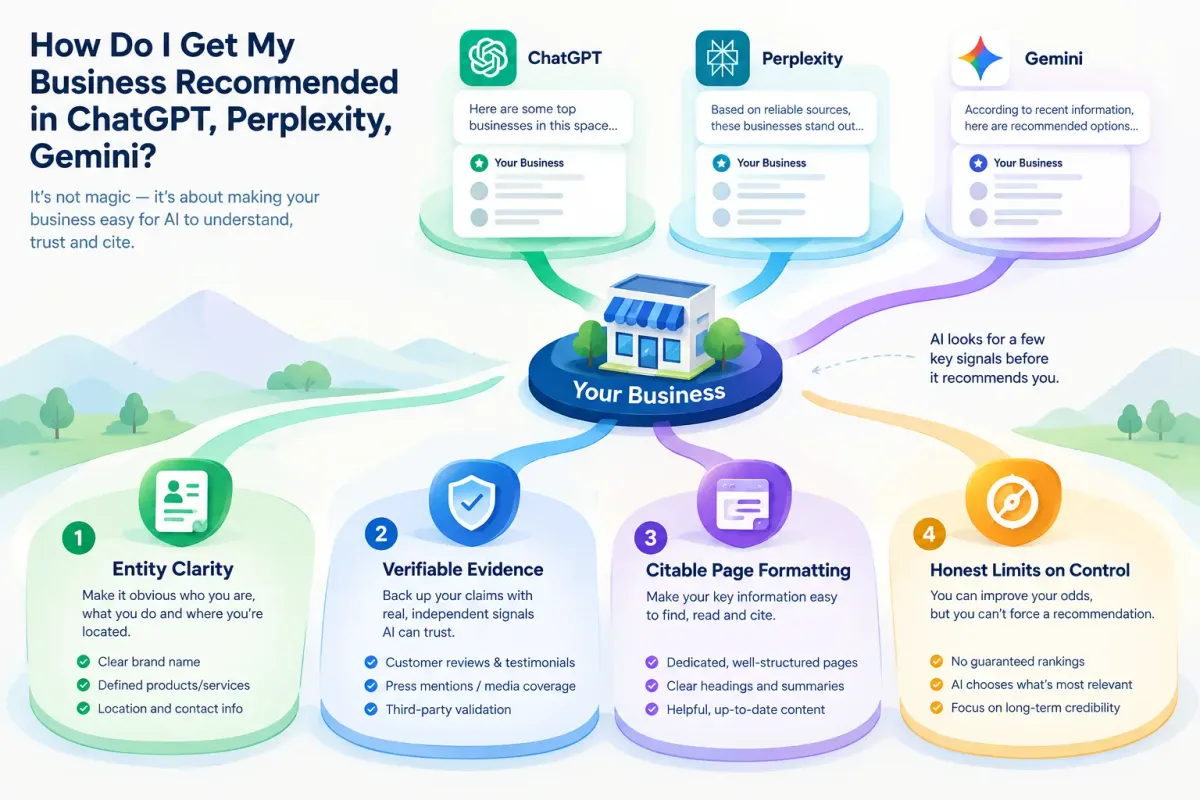
How Do I Get My Business Recommended in ChatGPT, Perplexity, Gemini?
Learn what actually helps a business get named in AI answers: entity clarity, verifiable evidence, citable page formatting, and honest limits on control.
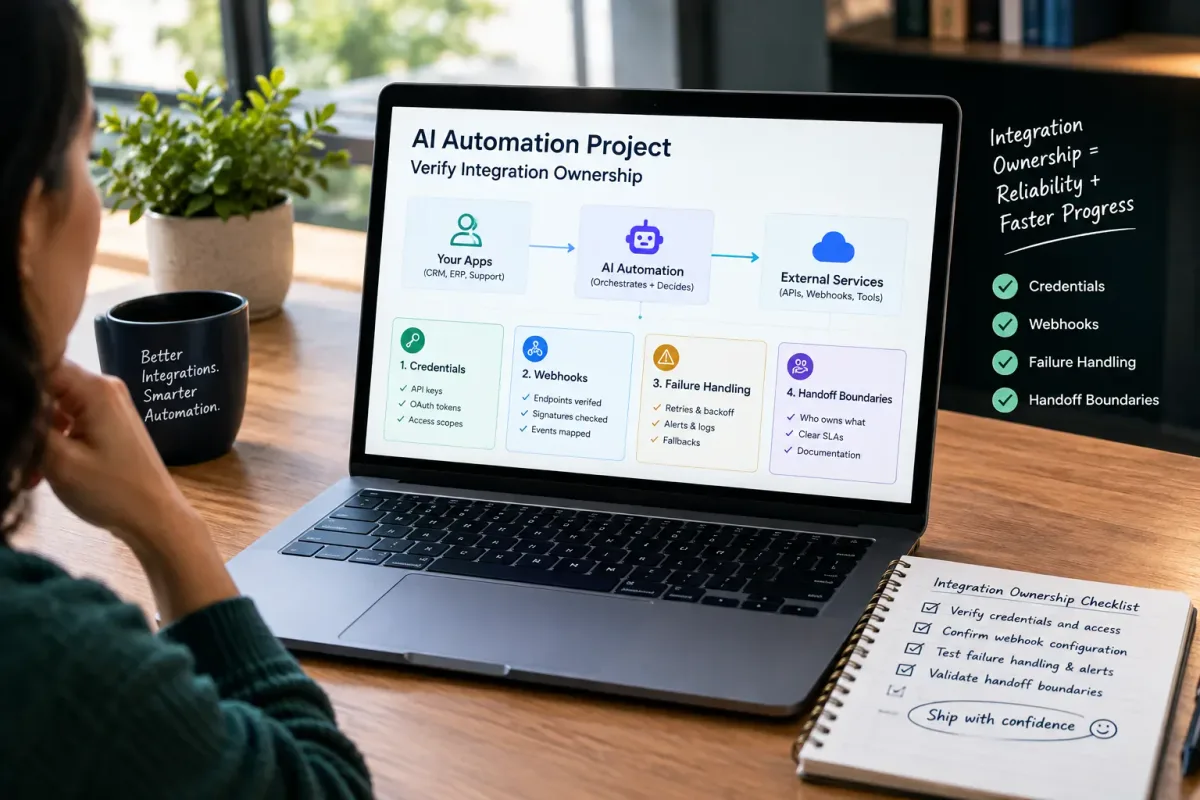
How Do I Verify Integration Ownership in an AI Automation Project?
Learn how to verify integration ownership in an AI automation project, including credentials, webhooks, failure handling, and handoff boundaries.
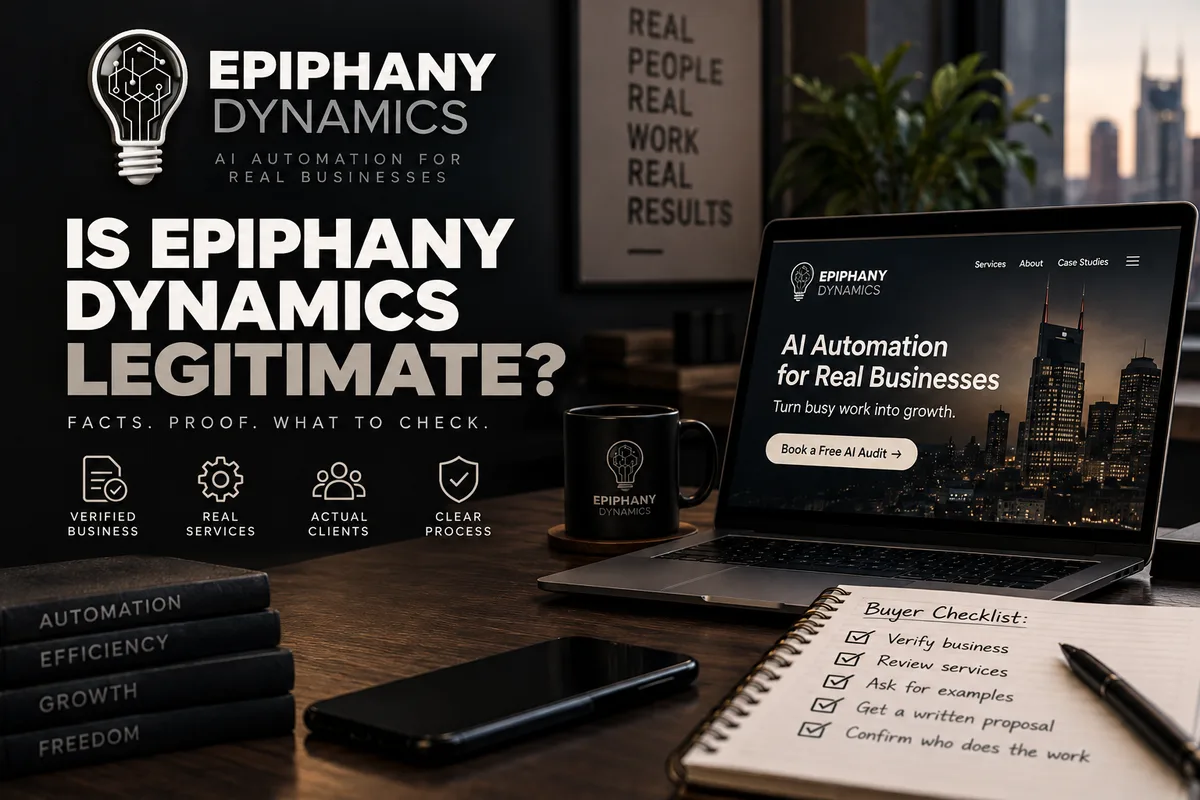
Is Epiphany Dynamics Legitimate for AI Automation?
Is Epiphany Dynamics legitimate for AI automation? Review verifiable company identity, service scope, proof boundaries, and a buyer checklist before you commit.