
Solutions & Services
AI Consultant Hourly Rate 2026: Real Costs by Project
See AI consultant hourly rates by role and engagement model, from generalist advisors to implementation specialists, so you can compare quotes without.
The free 30-minute AI Operations Audit is a conversation about a normal week in your business and where the work piles up. We find the one change that would give you the most time back and send you a plain-English plan for it. No forms and no pitch.
Book a free AI audit
Patrick Gibbs
The practical AI consultant hourly rate question is not just "what does a consultant charge?" It is "what kind of AI work am I buying?" The amounts below are hypothetical worksheet inputs, not a survey of actual quotes. Use these hypothetical quote scenarios to compare scope: a generalist-advisor scenario might use $75-$150/hour, an implementation scenario $150-$350/hour, an engineering scenario $250-$450/hour, and an executive-advisory scenario $500-$800/hour or more.
These are hypothetical consultant budgets for comparing a defined scope, not verified market ranges or an Epiphany Dynamics rate card. Epiphany Dynamics scopes each automation or consulting engagement after the free audit so the work matches the business case.
Why AI Consulting Rates Span Such a Wide Range
The illustrative gap between a $75/hour AI consultant and a $600/hour one is not about prestige or negotiating skill. "AI consulting" covers different disciplines: strategy, data engineering, model development, and deployment architecture. Each requires different expertise and commands a different market rate.
A mid-size manufacturer asking "should we use AI for demand forecasting?" needs a generalist advisor who can assess their data infrastructure, review a few tool options, and write a recommendation. A fintech company building a real-time fraud detection model from scratch is looking at a deeper machine learning engineering engagement with pipeline work and model tuning. Those are not the same job. Not even close.
For a broader view of what AI services cost across different categories, our AI automation pricing guide covers everything from phone answering to custom workflow builds. The clearest pricing driver is measurability of output. When a consultant's work directly produces something with a dollar value attached (an automated system, a trained model, a working integration), they price accordingly. When the work is advisory or exploratory, rates reflect that the ROI is harder to tie directly to their time. This isn't arbitrary. It's how every specialized professional services market works, and AI is no different.
AI Consultant Rate Ranges by Role and Specialization
For quote comparison, treat these as hypothetical quote scenarios: generalist advisors around $75-$150/hour, data scientists around $125-$250/hour, ML engineers around $200-$400/hour, AI solutions architects around $250-$450/hour, LLM and NLP specialists around $200-$375/hour, and an executive-advisor scenario above $600/hour.
| Role | Illustrative Hourly Range | Typical Engagement Type |
|---|---|---|
| AI Strategy Generalist | $75-$150/hr | Readiness assessments, tool selection, roadmaps |
| Data Scientist / Analyst | $125-$250/hr | Statistical modeling, dashboards, exploratory analysis |
| ML Engineer | $200-$400/hr | Model training, fine-tuning, production pipelines |
| AI Solutions Architect | $250-$450/hr | System design, integration planning, scalability |
| NLP / LLM Specialist | $200-$375/hr | RAG systems, LLM fine-tuning, chatbot deployment |
| AI Executive Advisor | $400-$800/hr | Board-level strategy, M&A AI diligence, org transformation |
Geography still shapes rates more than most clients expect. Contractors in expensive US tech markets usually quote differently from equally capable specialists in lower-cost regions. For remote-compatible projects, this gap can represent real budget difference. Vetted talent platforms that screen AI and ML specialists before listing them tend to price between direct offshore hiring and premium domestic consulting.
Independent contractors sourced through referrals often quote below platform rates because they're not paying marketplace commissions. The tradeoff is that you're doing the vetting yourself. That's worth the effort for longer engagements. For a short scoping project, a vetted platform may be worth the premium just to skip the screening process.
Freelancer vs. Agency vs. Boutique Firm: What You're Actually Paying For
The cheapest hourly rate is not always the cheapest engagement. As hypothetical comparison inputs, independent AI freelancers are modeled at $100-$300/hour, AI agencies around $250-$500/hour, and boutique AI firms around $175-$325/hour. The real comparison is flexibility, backup resources, process structure, and who carries delivery risk.
| Engagement Model | Illustrative Rate | Strengths | Risks |
|---|---|---|---|
| Independent Freelancer | $100-$300/hr | Low overhead, direct practitioner access | Single point of failure, limited accountability |
| Boutique AI Firm | $175-$325/hr | Team structure, process rigor, specialist backup | Less flexibility, some overhead baked into rate |
| AI Agency | $250-$500/hr | Bench strength, project management, liability coverage | Premium rate, practitioner may not be who you met in sales |
| Big 4 / Global SI | $350-$700/hr | Enterprise brand, compliance frameworks, scale | Junior staff on accounts, high overhead, slower pace |
The freelance option has a real risk that project managers tend to underweight: continuity. A solo contractor who gets sick, picks up a more interesting project, or doesn't work out mid-engagement creates a restart cost that never shows up in the hourly rate comparison. For a two-week audit, that's manageable. For a six-month model build, it's a serious operational risk worth pricing into the decision.
Boutique AI firms sit in a useful middle ground. Typically founder-led by practitioners who came out of larger consulting or tech roles, they offer practitioner-level technical depth plus enough team size to provide backup resources. Their example rates around $175-$325/hour should be compared with actual freelancer and agency quotes for the same scope and support.
Calculating ROI Before You Commit to Any Rate
The correct way to evaluate an AI consulting rate is not to compare it against other rates. Calculate the value of the outcome against the total engagement cost. A higher-rate consultant who delivers a system your team actually uses can be cheaper overall than a lower-rate consultant whose deliverable sits unused on a shared drive.
Before any engagement, run this math: take the conservative value of the outcome and divide it by the full consulting cost. If the project automates recurring labor your team can measure, the hourly rate matters less than adoption, reliability, and maintenance. If the deliverable is a strategic roadmap that may or may not get implemented, the ROI calculation is murkier, and that murkiness should affect how much you're willing to pay.
Watch the engagement structure as carefully as the rate. Hourly retainers work well for ongoing advisory work or iterative development where scope evolves naturally. Fixed-price contracts work better when deliverables and acceptance criteria are clearly defined upfront. The danger with open-ended hourly engagements is scope growth that never appeared in your budget conversation. Cap clauses protect you. Put them in the contract before the engagement starts, not after the first scope expansion request.
Red Flags That Signal the Rate Is Wrong (In Either Direction)
Overpriced AI consulting has a tell: high rates paired with vague or unmeasurable deliverables. A premium-rate consultant should describe exactly what success looks like and point to prior engagements with similar scope. Underpriced work carries its own risk: missed complexity in production deployment, leading to renegotiation or a system that fails outside a demo environment.
The clearest warning sign at the high end is rate-deliverable mismatch. Vague strategy sessions priced at enterprise levels. Presentations that could have been written by someone with no specific knowledge of your business or industry. Board-level advisory rates for work that a mid-level practitioner could execute. If a consultant can't describe what success looks like in concrete terms before the engagement starts, that's a problem regardless of what they charge per hour.
Underpricing carries different risks and people dismiss them too quickly. An unusually low quote for a production AI system may reflect offshore pricing, which can be fine if the work samples are strong, or it may mean the consultant has underestimated the scope. Both scenarios have the same downstream consequence: the project gets more expensive before it's finished, or the delivery doesn't meet production requirements. Neither outcome is actually cheap. Before signing any contract, ask them to walk through the specific technical steps involved in delivering the project. That conversation reveals whether their estimate reflects real understanding of the work or an optimistic read of a one-line description.
How to Structure the Hiring Process to Get the Rate Right
The most effective way to hire an AI consultant is to separate the scoping phase from the implementation phase. Pay for a bounded diagnostic engagement to define the problem precisely. Then use that specification to hire a specialized technical resource for the build. This prevents overpaying a generalist to do deep implementation work they're not optimized for.
Most businesses overpay for one of two reasons. They don't know what they need, so they hire a generalist at premium rates when they actually need a narrow implementation resource. Or they hire based on firm brand, paying enterprise-consulting rates for work that an independent specialist could execute with equal technical quality. Neither is necessarily wrong if you understand what you're buying. Both are expensive if you're operating on reputation alone.
Before requesting quotes from any vendor, build a scope document. It doesn't need to be long. A one-page description of the problem, current data availability, existing tech stack, and a clear definition of what "done" looks like produces comparable, apples-to-apples quotes. Our complete AI automation guide for small businesses can help you frame that scope document before you start soliciting proposals. Without it, every consultant is imagining a different project. The scope document costs you an afternoon. The missing one costs you in confusion, renegotiation, and timeline slippage.
Specific things to verify before signing: ask for references from two or more engagements with similar scope (not testimonials, actual references you can call and ask direct questions). Request a sample of their technical deliverables. At agencies, confirm who specifically does the work, because the person in the sales meeting is rarely the person writing the code or building the model. And understand the change order process before the contract is signed.
One last thing worth knowing: the AI consulting market is not uniform across specializations. Computer vision engineers, reinforcement learning practitioners, and enterprise LLM deployment specialists are genuinely harder to find than practical automation builders. As hypothetical comparison inputs, specialized frontier work is modeled at $400-$600/hour, while general automation work using off-the-shelf AI tools and APIs, the kind detailed in our best AI tools for service companies guide, is modeled in the $75-$175/hour conversation. Know which category your project falls into before you start talking to vendors, and you'll have a much better chance of paying a rate that actually reflects the value you're getting.
At Epiphany Dynamics, a free audit maps your workflow before we recommend a build. You get a fixed written quote for the scope before work starts.
Related guides: Use our AI consultant hiring guide for the vetting framework, compare software and support costs in the AI automation cost guide, and review how to test AI automation before scaling before committing to a larger engagement.
Get a fixed-scope AI build quote instead of open-ended hourly
Frequently Asked Questions
Q: What's the hourly rate difference between a generalist AI consultant and a specialized ML engineer?
As hypothetical quote scenarios, ML engineers and specialized roles are modeled at $200-$400/hour, while AI generalists are modeled at $75-$150/hour. The premium reflects deeper technical expertise and the direct measurability of their output, such as trained models or deployed systems. For projects requiring both strategic guidance and technical execution, a blended team approach is often more cost-effective than hiring a senior specialist for the entire engagement.
Q: What factors determine where an AI consultant falls within the typical hourly rate range?
The primary driver is specialization and measurable output. As hypothetical comparison inputs, strategic advisory work is modeled at $75-$150/hour, while production systems or complex solution architecture is modeled at $250-$450/hour. Client complexity, consultant reputation, geographic location, and whether the work produces tangible deliverables all influence where a quote falls.
Q: How much does a typical AI project cost for a small business?
As hypothetical comparison inputs, small business projects are modeled at $75-$150/hour for generalist advisors such as tool selection or workflow strategy, and around $150-$250/hour for specialized work like data integration or basic automation setup. For total project cost, ask vendors for a scoped fixed quote or a capped hourly estimate tied to clear deliverables.
Q: How do you know if an AI consultant's hourly rate is fair?
Match the consultant's specialization to your actual need. A $400/hour advisory quote and a $100/hour engineering quote cannot be judged from the price alone; these are hypothetical examples, not quality thresholds. Request references from similar projects, clarify what deliverables are included in the hourly rate, and benchmark each quote against the specialty required.
Patrick Gibbs
AI Automation Expert
Patrick Gibbs helps professional practices implement AI automation that captures more leads, books more appointments, and scales without adding overhead. He's the founder of Epiphany Dynamics and creator of the AI Front Desk system.
Related Solutions
Build this into a real workflow
Related Posts
AI Automation Agency for SMBs: What to Look For
A practical guide to choosing an AI automation agency for SMB workflows, from call intake and scheduling to CRM updates, follow-up, and maintenance.
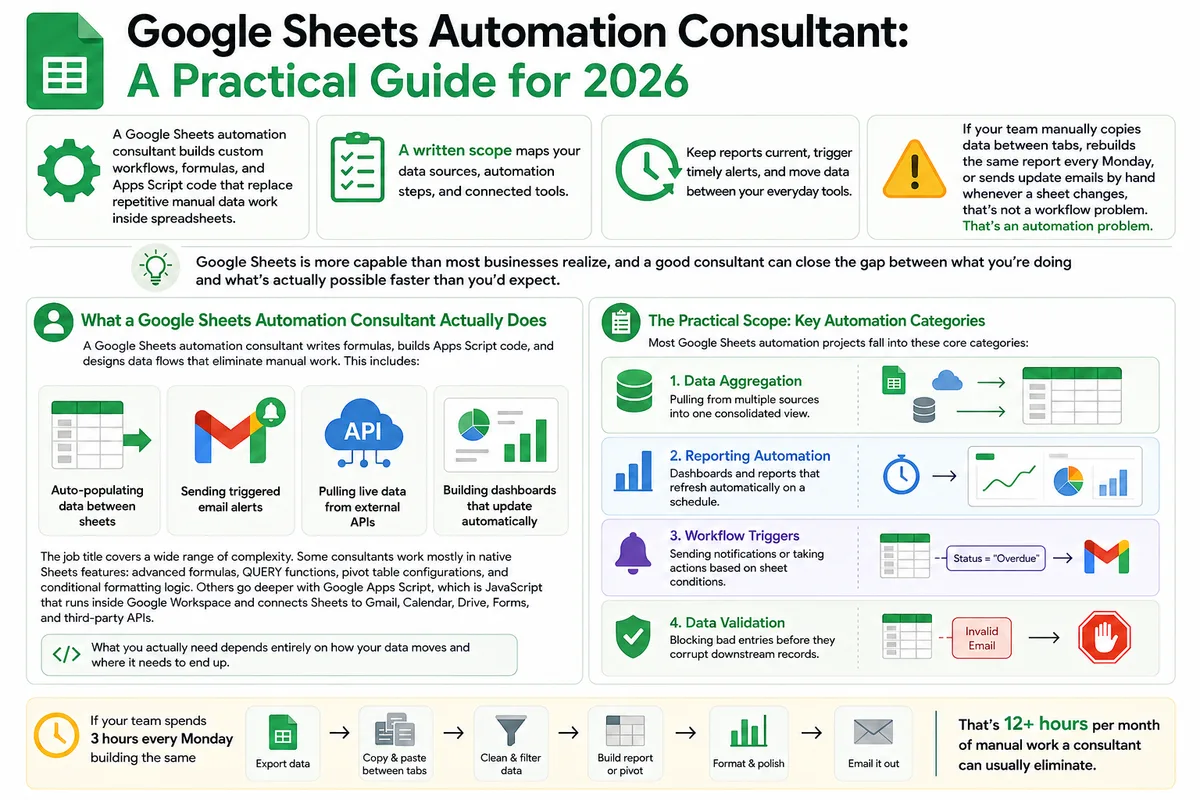
Google Sheets Automation Consultant: A Practical Guide for 2026
Most businesses don't track what spreadsheet work actually costs them. Here's what a Google Sheets automation consultant does in 2026, how to judge the value.

Business Process Automation Consultant for Small Business
Hiring the wrong automation consultant wastes thousands. Here's what small business owners need to know about process, cost, ROI, and how to vet the right one.