
E-commerce
Chatbot Integration for E-commerce: Converting Conversations Into Revenue
Learn how modern AI chatbots support e-commerce by answering product questions, reducing cart abandonment, and helping customers complete purchases.
The free 30-minute AI Operations Audit is a conversation about a normal week in your business and where the work piles up. We find the one change that would give you the most time back and send you a plain-English plan for it. No forms and no pitch.
Book a free AI audit
Patrick Gibbs
Chatbot integration in e-commerce addresses the core conversion gap between assisted retail and self-serve online shopping. The difference is real-time assistance. AI-powered chatbots that answer product questions, handle objections, and guide purchase decisions at the moment of intent can raise e-commerce conversion rates meaningfully, without adding sales headcount.
The E-commerce Communication Gap
Online shopping has a fundamental problem: it’s lonely.
Walk into a physical store, and a salesperson approaches within thirty seconds. They answer questions, make suggestions, handle objections, and guide you to purchase. That human assistance is one reason brick-and-mortar retail often converts at a much higher rate than self-serve online shopping.
Traditional e-commerce usually operates with far less live assistance at the moment a buyer hesitates.
The gap isn’t product quality or pricing: it’s the absence of real-time, personalized assistance when shoppers need it most. AI-powered chatbot integration bridges this gap, bringing the consultative sales experience to digital storefronts at scale. For service businesses specifically, our guide to website chatbots that actually convert covers the qualification and booking flows that drive real revenue.
Beyond Basic Bots: The New Generation of E-commerce Chatbots
First-generation chatbots were rule-based systems that responded to specific keywords with canned answers. They frustrated more customers than they helped.
Today’s AI chatbots are different:
Natural Language Understanding
Modern chatbots understand context, nuance, and intent. A customer asking “Do you have anything similar but cheaper?” receives relevant alternatives, not a confused “I don’t understand.”
Continuous Learning
Every conversation makes the system smarter. Chatbots learn your product catalog, common objections, successful rebuttals, and optimal timing for different interventions.
Omnichannel Presence
The same intelligent assistant operates across your website, mobile app, Facebook Messenger, WhatsApp, and Instagram DMs, maintaining conversation context across platforms.
Transactional Capability
Advanced chatbots don’t just answer questions; they process orders, handle payments, manage returns, and update shipping information, all within the conversation flow.
Key Use Cases for E-commerce Chatbots
Pre-Purchase Assistance
Product Discovery:
- “I need a gift for my wife who loves gardening”
- “What’s the best laptop for video editing under $1,500?”
- “Help me find running shoes for flat feet”
AI chatbots interpret these natural language queries, ask clarifying questions, and present curated recommendations, functioning as a digital personal shopper.
Comparison Assistance: When shoppers hesitate between options, chatbots provide relevant comparisons highlighting differences that matter based on the customer’s stated needs.
Inventory and Availability: Real-time stock checks, back-in-stock notifications, and alternative suggestions when preferred items are unavailable.
Cart Abandonment Recovery
Cart abandonment is a major drag across e-commerce. AI chatbots address this at multiple points:
During Shopping:
- Proactive engagement when hesitation is detected
- Answer questions that might otherwise derail purchase
- Offer assistance with sizing, compatibility, or specifications
At Abandonment:
- Immediate follow-up via preferred channel
- Address specific concerns based on cart contents
- Offer targeted incentives when appropriate
Post-Abandonment:
- Personalized reminder sequences
- Dynamic content based on browsing behavior
- Easy cart restoration with single-click return
For stores that want autonomous, multi-channel recovery rather than reactive chat, our AI agent for ecommerce cart recovery guide explains the difference between an agent and a chatbot, and how agents run personalized follow-up across email and SMS.
Post-Purchase Support
Order Tracking: Natural language order status queries (“Where’s my package?”) with proactive updates when delays occur.
Returns and Exchanges: Guided self-service returns, instant exchange authorization, and automated label generation.
Product Support: Setup instructions, troubleshooting, and usage tips delivered conversationally based on purchase history.
Implementation Strategy
Phase 1: Foundation (Weeks 1-2)
Platform Selection
Choose a chatbot platform based on your e-commerce stack:
| Platform | Best For | Key Features |
|---|---|---|
| Tidio | Small-medium stores | Easy setup, Shopify integration, affordable |
| Intercom | Growing businesses | Rich messaging, advanced targeting, strong analytics |
| Drift | B2B e-commerce | Conversational marketing, meeting booking, account-based |
| Custom GPT | Enterprise scale | Full customization, complex logic, proprietary training |
Basic Setup
- Connect to product catalog
- Configure greeting messages
- Build FAQ responses
- Set up handoff to human agents
Phase 2: Intelligence (Weeks 3-4)
Product Knowledge Training
Feed your chatbot:
- Complete product descriptions and specifications
- Common customer questions and effective responses
- Upsell and cross-sell recommendations by product
- Objection handling scripts
Intent Recognition
Map common customer intents to appropriate actions:
- Price inquiry → Show product with current pricing and promotions
- Stock inquiry → Check inventory, offer alternatives if unavailable
- Comparison request → Generate relevant side-by-side comparison
- Support question → Access knowledge base, escalate if unresolved
Phase 3: Optimization (Ongoing)
Conversation Analysis
Weekly review of:
- Unanswered questions (indicate training gaps)
- Abandoned conversations (identify friction points)
- Successful conversions (replicate winning approaches)
- Customer satisfaction scores
A/B Testing
Continuously test:
- Greeting message variations
- Response timing and proactive engagement triggers
- Promotional offer presentation
- Upsell and cross-sell recommendations
Measuring Chatbot Success
Track these metrics to ensure your chatbot investment drives ROI:
Engagement Metrics
| Metric | Target | Why It Matters |
|---|---|---|
| Conversation initiation rate | A meaningful share of visitors | Indicates relevance and visibility |
| Conversation completion rate | Strong completion without friction | Measures effectiveness |
| Average conversation duration | 2-4 minutes | Sweet spot for engagement |
| Return conversation rate | Healthy repeat engagement | Indicates customer satisfaction |
Business Impact Metrics
| Metric | Target | Why It Matters |
|---|---|---|
| Conversion rate lift | Meaningful increase | Primary revenue impact |
| Average order value lift | Higher influenced order value | Upsell/cross-sell effectiveness |
| Cart abandonment reduction | Noticeable decrease | Recovery success |
| Support ticket deflection | Significant inquiry deflection | Cost savings |
Efficiency Metrics
| Metric | Target | Why It Matters |
|---|---|---|
| First response time | Under 5 seconds | Customer expectation |
| Resolution rate without human | High self-service resolution | Automation effectiveness |
| Human handoff rate | Controlled escalation volume | Appropriate escalation |
| Customer satisfaction (CSAT) | 4.2+/5.0 | Quality assurance |
Advanced Tactics for E-commerce Success
Personalized Product Recommendations
Use conversation context to deliver recommendations that feel genuinely helpful:
Good: “Based on what you told me about needing waterproof hiking boots for winter, I’d recommend these three options. This one has the best insulation, this one is most durable, and this one offers the best value.”
Bad: “Here are some popular boots.” (Generic, unhelpful)
Dynamic Pricing Conversations
When price sensitivity is detected, chatbots can:
- Highlight value propositions specific to customer’s stated needs
- Present financing options for higher-ticket items
- Offer targeted discounts for first-time buyers or loyalty members
- Bundle complementary items to increase perceived value
Social Proof Integration
Weave relevant social proof into conversations naturally:
- “This laptop has a 4.8-star rating from over 2,000 customers. Most mention how quiet the cooling system is, which matters since you mentioned working in shared spaces.”
- “The blue color you selected is our best-seller. It’s currently in 847 other customers’ carts.”
- “Three customers in your area purchased this item in the last 24 hours.”
Common Mistakes to Avoid
The Uncanny Valley of Fake Humanity
Mistake: Pretending the chatbot is human with fake names and photos.
Solution: Be transparent about AI assistance. Customers appreciate honesty and will actually trust the bot more when they know what to expect.
Over-Automation
Mistake: Forcing every interaction through automation, even complex situations requiring human judgment.
Solution: Implement intelligent escalation. When sentiment turns negative, questions become complex, or high-value transactions are at stake, smoothly transfer to human agents with full conversation context.
Set-and-Forget Syndrome
Mistake: Deploying the chatbot and never updating its knowledge.
Solution: Schedule weekly reviews of conversations, update product information as your catalog changes, and continuously expand the chatbot’s capabilities based on customer needs.
The Future of E-commerce Conversation
The next evolution of e-commerce chatbots will include:
- Voice commerce integration: Conversational shopping via smart speakers and voice assistants
- Visual search: “Find me something like this” with image uploads
- Augmented reality previews: Product visualization within the chat interface
- Predictive engagement: Reaching out before the customer even asks, based on behavioral signals
Getting Started
If you’re not using AI chatbot technology on your e-commerce site, you’re leaving revenue on the table. Our complete guide to automating lead capture covers how chatbots fit into a full intake-to-qualification workflow. Your competitors are already implementing these systems and capturing the customers you’re losing to shopping friction. And if cart abandonment is the specific leak you want to close first, our AI agent for ecommerce cart recovery guide covers the autonomous multi-channel alternative.
This week’s action items:
- Audit your current conversion funnel and identify drop-off points
- Research chatbot platforms compatible with your e-commerce stack
- Document the 20 most common customer questions your team answers
- Start a free trial of one chatbot solution
- Measure baseline conversion rates before implementation
The businesses that master conversational commerce will own the future of e-commerce. For the broader picture of how AI automation drives revenue growth, chatbots are just one piece of a larger automation strategy. The question is whether you’ll lead or follow.
Frequently Asked Questions
Q: How much can an AI chatbot increase e-commerce conversion rates?
E-commerce chatbots that handle product questions, recommend alternatives, and address objections in real time typically convert meaningfully better than static product pages alone. The biggest gains come from reducing cart abandonment, where proactive chatbot engagement during hesitation moments recovers a real share of would-be abandoned carts.
Q: Will customers trust an AI chatbot for product recommendations?
Customers trust AI recommendations when the chatbot is transparent about being AI, provides relevant and specific suggestions based on their stated needs, and includes social proof like ratings and reviews in its responses. Generic recommendations erode trust; contextually relevant ones build it. The key is training the chatbot on your product catalog deeply enough to give genuinely useful guidance, not just surface popular items.
Q: What’s the best e-commerce chatbot platform for a small to mid-size store?
Tidio is the most popular choice for small to mid-size e-commerce stores because it integrates natively with Shopify and WooCommerce, requires no technical expertise to set up, and offers a free tier to start. For stores with higher volume or more complex product catalogs, Intercom provides richer targeting and analytics. Enterprise-scale stores typically build custom solutions on top of GPT-based APIs.
Q: How do I prevent my e-commerce chatbot from frustrating customers?
Three practices prevent most chatbot frustration: always identify the bot as AI upfront, make it easy to reach a human at any point in the conversation, and never force customers through the chatbot to complete a purchase. The most common source of frustration is a chatbot that traps users in loops when they need something outside its training: build a clear “connect me to a person” escape hatch that works every time.
Q: How should I measure whether my e-commerce chatbot is working?
Track four core metrics: conversation initiation rate (what share of visitors engage), resolution rate without human handoff, conversion rate among chatbot users versus non-users, and average order value from chatbot-influenced sessions. Any improvement in cart abandonment rate is also directly attributable to chatbot engagement. Review conversation transcripts weekly to identify where customers are getting stuck or leaving.
Patrick Gibbs
AI Automation Expert
Patrick Gibbs helps professional practices implement AI automation that captures more leads, books more appointments, and scales without adding overhead. He's the founder of Epiphany Dynamics and creator of the AI Front Desk system.
Related Solutions
Build this into a real workflow
Related Posts
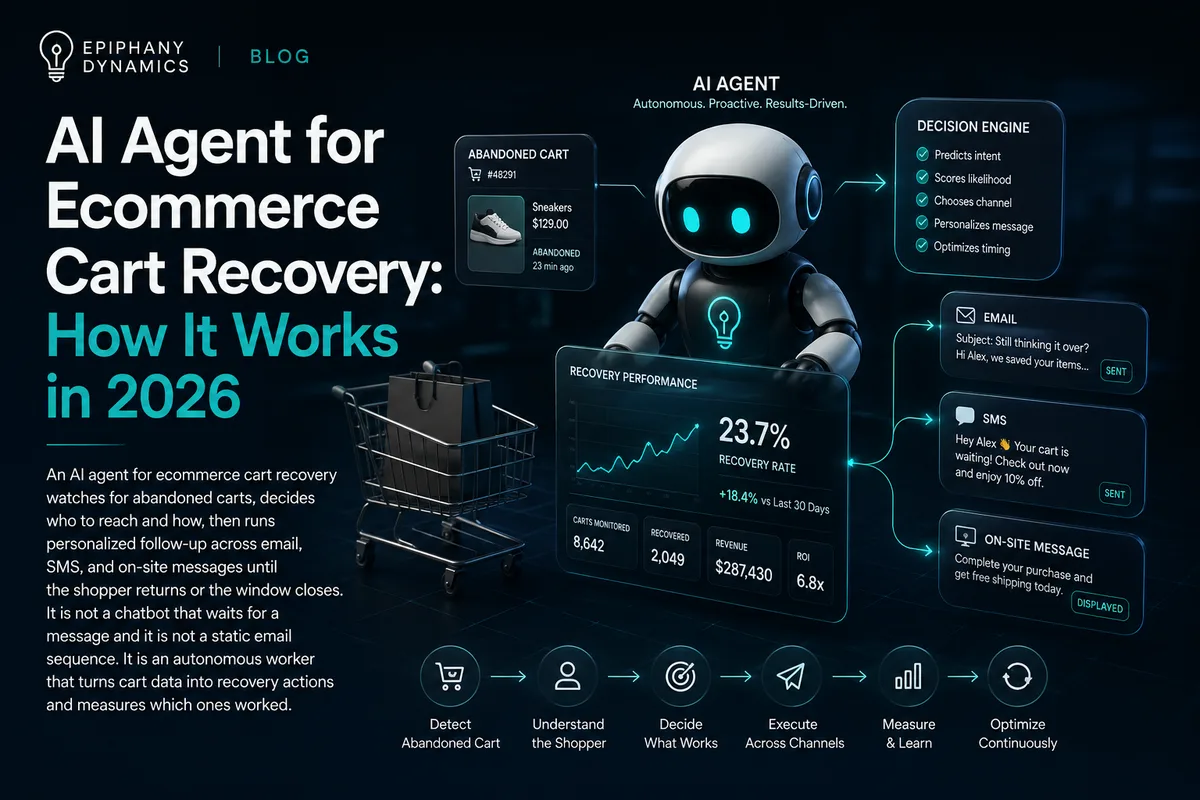
AI Agent for Ecommerce Cart Recovery: How It Works in 2026
AI agents recover abandoned ecommerce carts automatically. How they work across email and SMS, what they cost, and how to pick one for your store.
Website Chatbots That Actually Convert: A Blueprint for Service Businesses
Stop losing website visitors. Learn how to build AI chatbots that engage, qualify, and convert casual browsers into booked appointments.
The 5-Minute Rule: Why HVAC Companies That Answer First Win the Job
Research on lead response times shows the first company to answer usually wins the job. Learn why the 5-minute rule matters in HVAC, and how to hit it.